Build It, or Buy It? The Calculation Has Changed

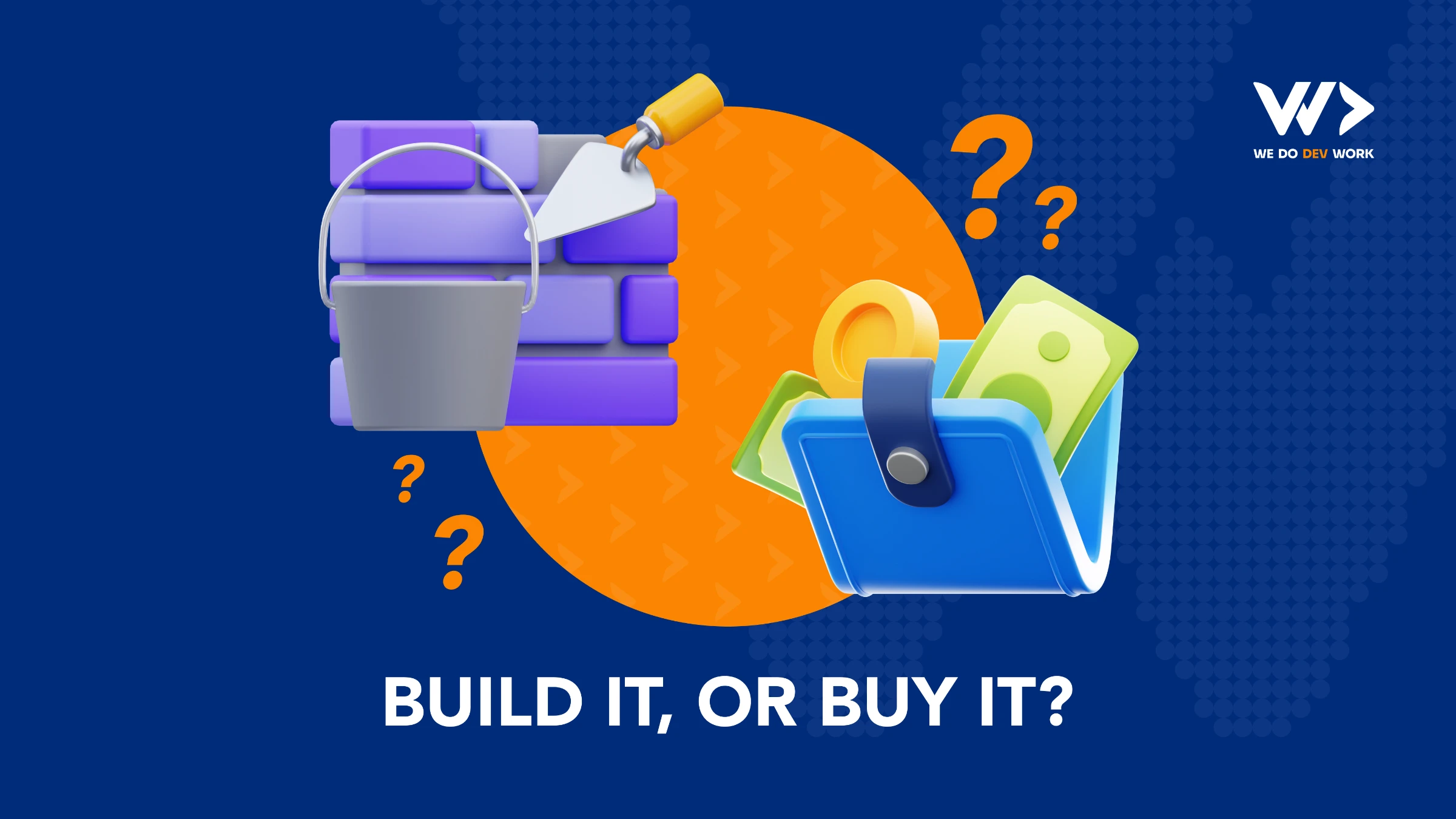
Over the past few months, we've been doing something at We Do Dev Work that, ironically, I probably wouldn't have recommended a few years ago.
Every time someone proposes a new SaaS subscription, or every time we review the software we're already paying for, we ask ourselves one simple question.
If this product didn't exist today, would we still buy it, or would we build exactly the functionality we need ourselves?
A few years ago, that question would have been answered almost immediately.
Buy it. Move on. Focus on your business.
Lately, the answer has become a lot less obvious.
That doesn't mean we've suddenly turned against SaaS. Quite the opposite. We use plenty of SaaS products ourselves, from GitHub to Google Workspace, Design tools and Monitoring tools, and I suspect that list will only grow over the coming years.
What has changed isn't SaaS, it's the calculation.
And I don't think enough businesses have realised that yet.
For years, the answer was simple
For most of the past two decades, one piece of advice was almost universally accepted.
Don't build something you can buy.
Honestly, it was excellent advice.
Building software was expensive. Infrastructure wasn't cheap, development teams were smaller, cloud computing was still evolving and every new feature meant more development, more testing and more maintenance for a single customer.
Meanwhile, SaaS companies had figured out something incredibly powerful.
Instead of one business paying the full cost of development, thousands of customers could share it through a monthly subscription. Suddenly, sophisticated software that had once been reserved for banks, governments (well, yeah) and multinational corporations became accessible to small and medium-sized businesses.
It was one of the biggest shifts our industry has ever seen.
Need a CRM? Buy one.
Need accounting software? Buy one.
Need an e-commerce platform? Buy one.
There was very little reason to spend months rebuilding something that already existed.
And that advice is still correct remarkably often.
SaaS didn't become worse
Sometimes people read articles like this and assume I'm about to argue that every business should replace SaaS with custom software.
I'm not.
That would be just as silly as claiming every company should develop its own email platform because Microsoft exists.
There are products that have had billions invested in them over decades:
Microsoft 365
Google Workspace
Slack
Stripe
Shopify
Payroll software
Please don't rebuild those. Seriously.
If you wake up with the idea to build your own Payment Gateway, I suggest you to grab a very strong coffee, check your bank account and move on to your next idea.
Some problems have already been solved extraordinarily well, and you're not gaining a competitive advantage by spending two years trying to catch up.
So if SaaS didn't suddenly become worse, what changed?
Building software became cheaper.
AI quietly moved the break-even point
I deliberately say cheaper, not free.
I recently wrote another article explaining why AI hasn't magically eliminated the cost of software development, and I still stand by every word of it.
Engineering still matters
Quality assurance still matters
Security still matters
Experienced developers matter more than ever
But there's no denying that AI has dramatically reduced the time required for many repetitive development tasks. Boilerplate code, documentation, research, unit tests, standard integrations and dozens of other activities that used to consume hours can now often be completed in a fraction of the time.
That doesn't mean software suddenly costs nothing.
It does mean the economics have changed, the past half decade.
We're comparing the wrong things
This is probably the biggest misconception I encounter.
A company pays €400 or €500 per month for a SaaS platform, someone suggests building an alternative for €40,000. Immediately the conclusion seems obvious: buying is tenfold cheaper.
Except that's not the right comparison.
Keep in mind that you’re rebuilding your workflow, not the SaaS product you are using.
Imagine you're using a CRM with, let’s say, 250 features.
How many do you actually rely on every day? 20? 10? 5?
If those few features support the way your business operates, while the remaining 240 mainly exist because thousands of other companies need them, you're no longer comparing like with like.
You're comparing someone else's complete product with your own very specific requirements. Those are fundamentally different calculations.
Nobody wakes up one morning and decides to compete with Salesforce, at least I sincerely hope they don't.
What they might decide is that their sales team only uses a handful of features, their reporting happens elsewhere anyway and half the workflow consists of adapting to the software instead of the software adapting to them.
Now the calculation becomes much more interesting. Don’t you think?
SaaS optimises for everyone
This isn't a criticism. It's simply how the business model works. Trust me, we had plural SaaS product clients over the years.
A SaaS company has to build software that works reasonably well for thousands, sometimes millions, of customers.
Your business only has one customer: you and your team.
Your workflows, your approval process, your pricing model, your logistics, your internal terminology and your way of working are unique to your organisation.
The SaaS provider won’t optimise for that, at best they give you hacks around that.
Keep in mind:
They're building a product
You're running a business
Those objectives are completely different.
The hidden cost isn't always the subscription
One thing we've started noticing, both internally and with clients, is that the monthly subscription often isn't the biggest cost anymore.
Let's say you're paying €300 per month for a perfectly decent piece of software. That's €3,600 per year, which for many businesses isn't exactly something that keeps the finance department awake at night.
The interesting question is everything around it:
Who maintains the integrations?
Who updates them when an API changes?
Who trains new employees?
Who manually copies information because System A doesn't quite understand System B?
Who spends Friday afternoon wondering why the automation that worked perfectly yesterday suddenly decided today was a good day to stop working?
The software itself may not be expensive, but the ecosystem around it sometimes is.
And I think that's something businesses have started underestimating.
We've caught ourselves doing exactly the same thing
This article wasn't inspired by one client asking whether they should build or buy.
It actually started because we looked at our own subscriptions.
Not because we were trying to save money. Software generally isn't the biggest cost inside a software company anyway.
We simply realised that every subscription deserves the same question.
Would we still buy this today? Sometimes the answer is immediately yes.
Why on earth would we build our own accounting software? Or replace GitHub? Or try to compete with Shopify? That's not where our expertise creates value.
But occasionally the answer becomes less obvious.
We were paying for a Project Management with hundreds of features, yet our team only touches a handful of them. The rest isn't bad software. It simply solves problems we don't have. We built our own.
Five years ago we'd probably have shrugged our shoulders and kept paying.
Today we at least make the calculation.
Build where you're different
This is where I think many build-versus-buy discussions go wrong.
People compare products.
I think they should compare processes.
If your software does exactly the same thing as every one of your competitors, there's a good chance you should simply buy it. Payroll doesn't make your company unique. Neither does accounting. Neither does email.
But the moment software starts reflecting how your company actually works, how you calculate prices, how projects flow through the organisation, how customers interact with you or how your operations differ from everyone else's, you're no longer buying a generic tool.
You're buying compromises.
Sometimes those compromises are absolutely worth making.
Sometimes they're not.
And that's precisely why I believe the question has become more interesting over the past few years. Not because AI suddenly made custom software free, but because it moved the point where those compromises stop making financial sense.
A worked example: 3 years of SaaS versus 3 years of build
This is an illustrative example with made-up numbers, not a quote and not a real vendor's price. Replace every figure with your own. The point is the shape of the calculation, not the result.
Assumptions:
- A SaaS tool that costs €45 per user per month (hypothetical), used by 40 people.
- Your team really uses about 10 of its features, and a custom tool covering only those is estimated at 35 developer days.
- Build cost at our project rate of €495 per day for a senior developer (see our pricing).
- Maintenance, bug fixes and small changes at about €480 per month, which is where our monthly hours start.
- Hosting of €50 per month (assumption). Price rises, discounts, VAT, internal staff time and the cost of switching are left out.
| Cost over 36 months | Buy (SaaS) | Build |
|---|---|---|
| Subscription: 40 seats x €45 x 36 | €64,800 | - |
| Build: 35 days x €495 | - | €17,325 |
| Maintenance: €480 x 36 | - | €17,280 |
| Hosting: €50 x 36 | - | €1,800 |
| Total | €64,800 | €36,405 |
In this scenario building is about €28,000 cheaper over three years, and most of that comes from the seat count. Now change one assumption: with 10 users instead of 40, the SaaS costs 10 x €45 x 36 = €16,200, and building at €36,405 loses clearly. Same tool, same build, opposite answer. That is why you do the maths with your own numbers instead of trusting a general rule.
What the table does not show: the build also needs someone on your side to define requirements and test, the SaaS comes with features you may need next year, and a custom tool you stop maintaining becomes a liability. For that last point, read The cost is not zero. For an example of owning your own tooling, see how we take total control of our operations at WDDW, and for what we have built for others, browse our projects.
Decision checklist: build or buy
- Does this software reflect how we differ from competitors (pricing, workflow, operations), or is it a commodity such as payroll or email? Commodity: buy.
- Can we list the 5 to 10 features we use every day, in writing?
- Have we calculated 3 years of subscription, including growth in seats and likely price rises?
- Have we got an estimate for the build and for monthly maintenance, not just the build?
- Who owns it internally: who writes requirements, tests and decides priorities?
- What does it cost us today in workarounds, manual copying and broken integrations?
- What happens if the builder disappears? Is the code ours, documented and hosted where we control it?
- Are security, backups and compliance requirements covered in the build estimate?
- Could we start with a small build around the SaaS (an integration or one module) before replacing it?
- If the numbers are close, which option is easier to reverse?
If you want a second pair of eyes on your own numbers, see how we price or look at what we have built.
So... build it or buy it?
If you've read this article hoping I'd tell you that every company should start replacing SaaS with custom software, I'm afraid you'll be disappointed.
I don't believe that's where we're heading.
In fact, I think we'll see more SaaS products over the next decade than we've ever seen before. AI is making it easier to build software, which means we'll probably end up with thousands of highly specialised products solving increasingly specific problems. That's a good evolution.
What I do think is changing is the question businesses should ask.
For years it was:
Can we afford to build this ourselves?
For most companies, the answer was no.
Today, I think the better question is:
What do we actually need?
That's a subtle difference, but it completely changes the calculation.
You're no longer comparing your company with an entire SaaS platform containing hundreds of features.
You're comparing your own workflow with the handful of features your business genuinely relies on every day.
Sometimes you'll conclude that buying software is still by far the smartest decision. In fact, I suspect that will remain true more often than not.
Sometimes you'll discover that you've quietly adapted your business around somebody else's roadmap for years, while building exactly what you needed would have been the better long-term investment.
Neither answer is right or wrong.
The mistake is assuming you already know the answer before you've done the maths.
AI hasn't killed SaaS.
It has simply moved the needle where building software starts making business sense.
And I have a feeling that, over the next few years, more and more companies are going to discover that the answer isn't as obvious as it used to be.
Frequently asked questions
Is it cheaper to build software than to buy SaaS?
It depends on seats, scope and time horizon. In our illustrative example, 40 seats favoured building over 3 years, while 10 seats favoured buying.
How do you calculate build vs buy?
Add up 3 years of subscriptions (seats x price x months) and compare with build days x day rate plus monthly maintenance and hosting.
What does custom software maintenance cost?
Plan for it explicitly. In our example we used €480 per month, which is where our monthly hours start; your needs may be higher.
Which software should you never build yourself?
Mature commodity products such as email, office suites, payment gateways, payroll and e-commerce platforms.
Does AI make custom software free?
No. AI reduces time on repetitive tasks, but engineering, testing, security and maintenance still cost money.
What is the biggest hidden cost of SaaS?
Often the work around it: integrations, API changes, training and manual copying between systems.
Related articles
Developer Disappeared? How to Get Your Site and Code Back
Your web developer stopped responding or the agency went bust. How to recover your domain, hosting, code and app store accounts, and who can take over.

Cost to Hire a Developer in 2026: 4 Options Compared
What it really costs to hire a developer in 2026: freelancer, agency project, dedicated developer or own employee, with employer costs, notice and hiring time.
Software Maintenance Retainer vs Pay As You Go (2026)
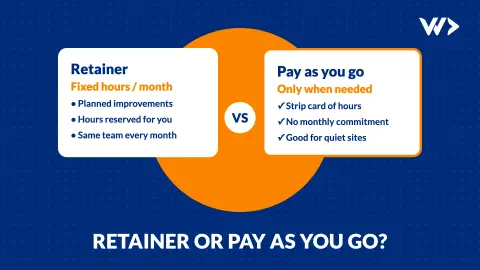
Retainer, prepaid hours or hourly? Worked examples at 5, 20 and 50 hours a month with real prices, plus what software maintenance should cover.