
Cost to Hire a Developer in 2026: 4 Options Compared

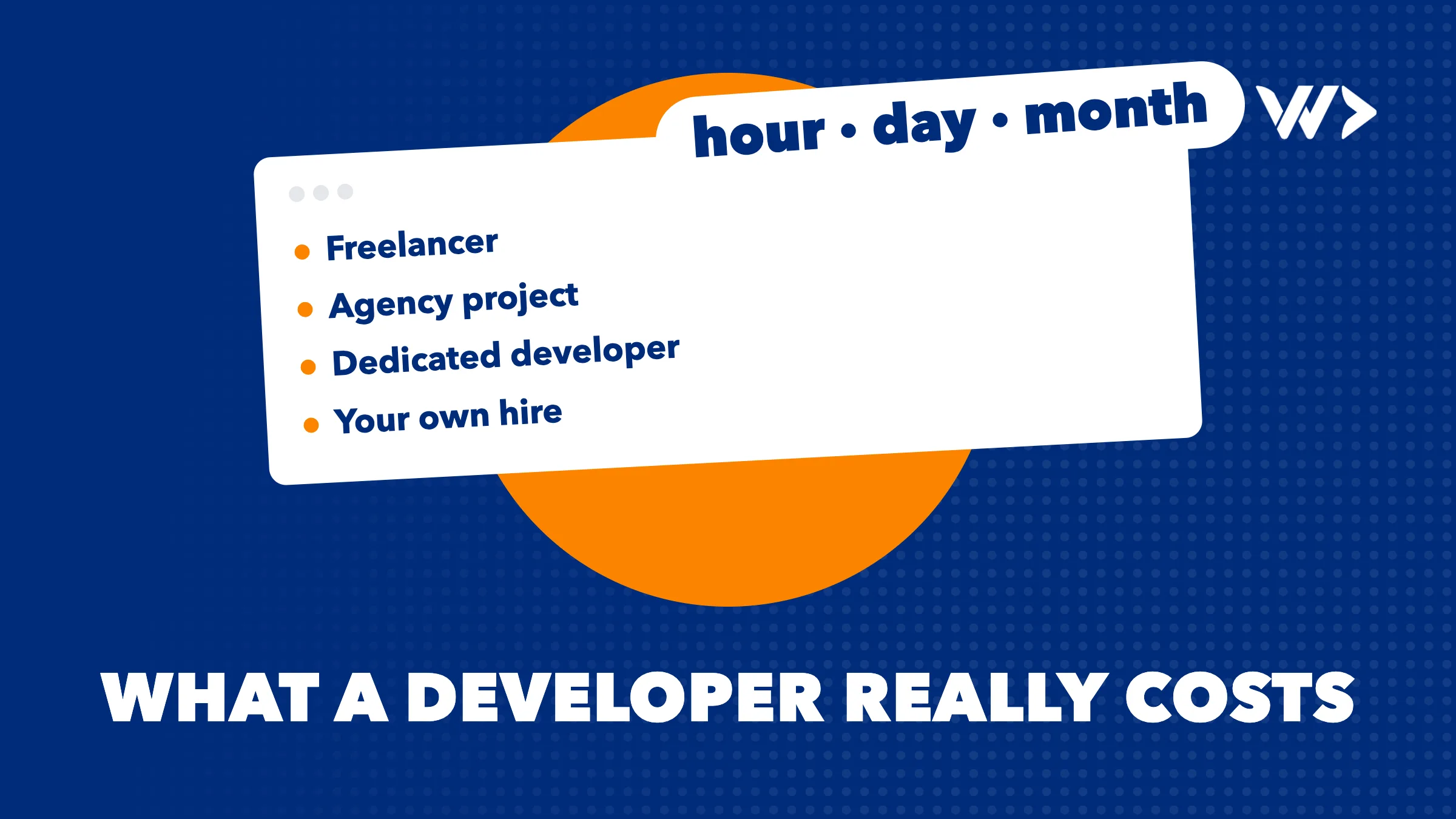
Hiring a developer in 2026 costs about $68 an hour for a senior US freelancer (the median developer rate on Lemon.io contracts, before any platform margin), by our estimate roughly $194,000 a year all-in for a US employee at the median software developer salary, and $75 to $85 an hour or $11,400 a month for a senior developer through us. But the hourly rate is the smallest part of the decision. The real cost is set by how fast someone can start, what you pay on top of the salary, how hard it is to stop, and what happens to your project when that person leaves. This guide puts the four common options side by side: a freelancer, an agency project, a dedicated developer through an agency, and your own employee.
The four options at a glance
| Freelancer | Agency project | Dedicated developer (via us) | Your own employee | |
|---|---|---|---|---|
| How you pay | Per hour or per job | Per day of work, or a fixed price | Per month | Salary plus benefits, payroll taxes and recruiting |
| Typical cost | Senior US median about $68/hour (developer rate, before platform margin) | With us: $575/day senior, $795/day lead | $7,900 to $15,900/month | Roughly $16,200/month at the US median salary, all-in (our estimate) |
| Time to start | Days to weeks, if they are free | With us: usually within one or two weeks | Usually within one or two weeks | Weeks to months of recruiting, then their notice at the current job |
| Commitment | Per job | Per project, no minimum with us | 6 months, then 3 months' notice | Employment contract and local labour law |
| If they are ill or leave | Your problem, and the knowledge leaves with them | The agency staffs the work | We replace them fast | You keep paying, then recruit again |
| Your management time | High: you brief, review and test | Low: weekly progress and hours report | Medium: they join your stand-ups, we handle the rest | High: hiring, managing, reviews, retention |
| Best for | A small, well-defined job | A build with a clear goal | Ongoing full-time work | A core product you will develop for years |
Option 1: a freelancer
A freelancer is the fastest way to buy a few hours of a specific skill. Rates vary widely by country and platform. Lemon.io, which publishes rates from 4,058 active US contracts, puts the median for a senior US developer (5 to 8 years) at $68 an hour and for a strong senior (8+ years) at $76 an hour in Q3 2026. These are the rates developers earn on that platform, not necessarily what a client pays: a platform or broker usually adds its own margin on top.
What the hourly rate leaves out:
- Your time. With one freelancer, you are the project manager. You write the brief, answer questions, review the result and test it.
- Availability. Good freelancers are booked. When a bigger client calls, your small job waits.
- Continuity. When the job ends, the knowledge of your code leaves with them. The next developer starts by reading it all again.
- Full-time maths. By our estimate, at $68 an hour for about 160 hours, a full-time freelancer costs roughly $10,880 a month, close to the price of a dedicated developer, without the backup.
Option 2: your own employee
The US Bureau of Labor Statistics puts the median annual wage for software developers at $135,980 (May 2025). That is not what the developer costs you. In June 2026, benefits made up 30.0% of employer compensation costs in US private industry (31.5% for full-time workers). Our estimate based on those two figures: if the salary is about 70% of the total, a developer at the median costs roughly $194,000 a year, or about $16,200 a month. That still leaves out recruiting fees, a laptop, software licences and the hours your team spends interviewing.
Then there is time. Recruiting a developer takes weeks to months, and the best candidates already have a job, so they first work out their notice. When someone leaves, you go through all of it again, and until the replacement knows your code, the work slows down.
Your own hire makes sense when software is the core of your business, you have enough work for years, and someone in-house can lead and review a developer. One developer with nobody to check their work is a risk of its own.
Option 3: an agency project
For a build with a clear goal, such as a new feature, an integration or a rebuild of a slow checkout, you pay for days of work. Agencies either quote a fixed price or work on time and materials. We work on time and materials: a senior developer at $575 a day, or a lead developer at $795 a day for architecture, code review and leading our developers. You get a weekly progress and hours report, we work in your repository, and there is no minimum. You meet the developer before you decide.
A day rate is higher than a salary divided by working days, because the agency carries the costs you would otherwise carry: recruiting, holidays, sick days and the time between projects. What you avoid is a long commitment for work that ends.
Option 4: a dedicated developer through an agency
This sits between a freelancer and your own hire: a full-time developer who works in your team, your tools and your stand-ups, while the agency employs them. With us, a medior developer is $7,900 a month, a senior $11,400 and a lead $15,900. By our calculation, at about 160 hours a month a senior works out to roughly $71 an hour, close to the freelance median, but full-time and with backup.
The minimum is 6 months, then 3 months' notice. If the developer is ill or leaves, we replace them fast, and because other people in our team know your code, the knowledge stays. Our developers speak English, Thai, Dutch, German or French. Compared with a US hire at the median salary, a dedicated senior costs roughly $4,800 a month less by our estimate and starts without a recruiting process. The honest trade-off: they are not your employee. If you are building a long-term in-house engineering team, a hire may still be the right call, and a dedicated developer can bridge the months until that person starts.
What we charge
All prices in USD, excluding VAT.
| Offer | Price | Terms |
|---|---|---|
| Emergency help | $85/hour | Senior developer, starts the same day, no minimum, no intake |
| Strip card | $1,050 for 14 hours (about $75/hour) | We start within 24 hours, hours deducted as we work, valid 4 months |
| Subscription | $550/month (8 h), $2,200 (32 h), $4,400 (64 h) | At least 3 months, then 3 months' notice; unused hours don't roll over |
| Project | $575/day senior, $795/day lead | Time and materials, weekly progress and hours report, no minimum |
| Dedicated developer | $7,900 medior, $11,400 senior, $15,900 lead per month | Full-time in your team, 6 months minimum, then 3 months' notice |
You own the code and we work in your repository. We also work white-label for agencies. All offers are on our pricing page.
How to decide
Match the option to the amount and shape of the work, not to the lowest hourly rate.
- A few hours of work (a bug, a small change, a plugin update): use a strip card, or emergency help if something is down. Recruiting anyone for this costs more in time than the work itself.
- Small work every month: a subscription. Growth gives 32 hours for $2,200, about $68.75 an hour, with same-day response.
- A build with a clear goal: project days. Ask for weekly reports and keep the code in your own repository, so you can stop or switch at any time.
- An ongoing full-time need and no time or wish to recruit: a dedicated developer.
- Software is your product, you have years of work and a senior to lead: hire your own, and bridge the recruiting months with project days or a dedicated developer.
Whichever you choose, ask these questions before you sign:
- Is the code in my repository, and do I own it?
- What happens if the developer is ill for two weeks or leaves?
- How do I see the hours spent, and how often?
- What is the notice period, on both sides?
- Who reviews the code before it goes live?
Not sure what state your website or app is in? Run a free audit on EngineeringScore. It checks security, performance, SEO, accessibility and reliability, and gives whoever you hire a clear starting point. For more on working with outside teams, read how to work with a software agency, our checklist for choosing an outsourcing partner and outsourcing software development to Thailand.
Get a developer without the recruiting
Tell us what you need: the stack, the work, the hours per week and when you want to start. We suggest a developer who fits, you talk to them first, and they start in your repository and your tools. For a few hours, a project or a full-time team member, start on our hire a developer page or contact us.
Frequently asked questions
How much does it cost to hire a developer per hour?
A senior US freelancer earns a median of about $68 an hour on Lemon.io contracts (Q3 2026); that is the developer's rate on the platform, not necessarily what a client pays. With us, a senior developer costs about $75 an hour on a strip card or $85 an hour for same-day emergency help.
What does a full-time developer employee really cost?
The US median wage for software developers is $135,980 a year (BLS, May 2025). With benefits at about 30% of total employer costs, our estimate is roughly $194,000 a year, before recruiting, equipment and licences.
Is a freelancer cheaper than an agency?
Per hour, often yes. But you manage the work yourself, the freelancer may not be available when you need them, and their knowledge of your code leaves when the job ends.
How fast can a developer start?
With us, emergency help starts the same day and a strip card within 24 hours. A project or full-time developer usually starts within one or two weeks, after you have met them.
What is a dedicated developer?
A full-time developer who works in your team and tools but is employed by the agency. With us it costs $7,900 to $15,900 a month, with a 6-month minimum, and we replace the developer fast if they are ill or leave.
Who owns the code when I hire through an agency?
That depends on the contract, so check it. With us you own the code and we work in your repository.
Related articles
White Label Web Development: How It Works, What It Costs
White label web development for agencies: how it works under your name, three ways to buy it, market rates and margins, and how to check a partner first.

Software Maintenance Retainer vs Pay As You Go (2026)
Retainer, prepaid hours or hourly? Worked examples at 5, 20 and 50 hours a month with real prices, plus what software maintenance should cover.

Odoo and Peppol: e-invoicing in Belgium
Belgian e-invoicing in Odoo: what the 2026 Peppol rules require, what Odoo's free access point covers, when to connect Billit or Silverfin, and the cost.