
How Software Developers Killed the Music Industry

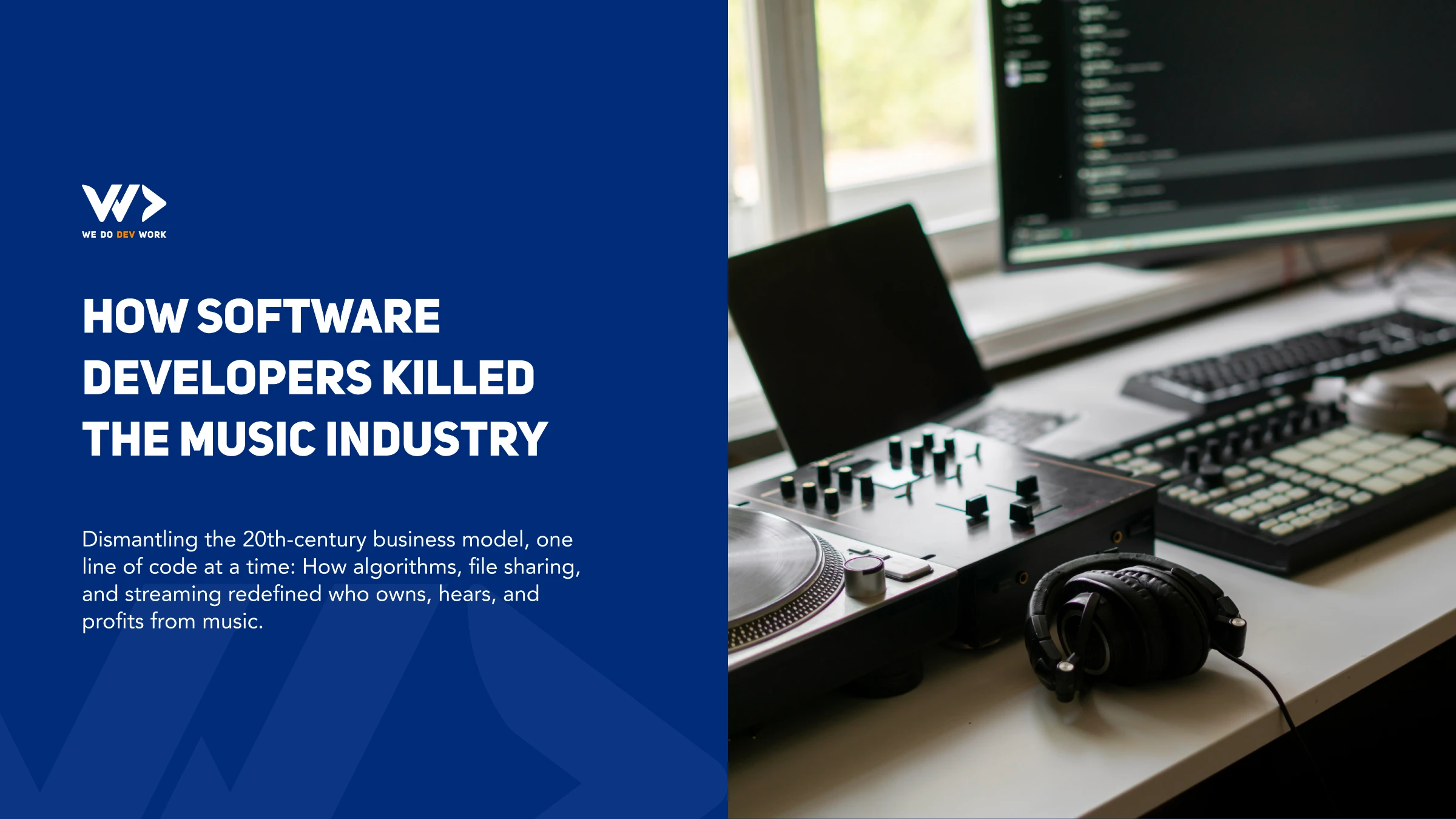
I have a few passions in life: building software, online platforms, and playing music.
And it seems my first passion ruined my chances at a musical career.
That’s a convenient story to tell, at least. One where developers, platforms, and algorithms replaced talent, labels, and record stores. One where code quietly pulled the rug from under guitars and drum kits.
But like most convenient stories, it’s not entirely true.
When Music Was Physical
Before software touched everything, music was tangible.
You went to a record store. You browsed. You asked for recommendations from friends. Read local printed magazines. You bought an LP or a CD, brought it home, and played it from start to finish. Albums were experiences, not just collections of songs.
Distribution was limited. If you weren’t signed, you didn’t exist at scale. Labels controlled access, radio decided what was popular, and geography mattered. A band in Belgium could be unknown in the Netherlands.
There was scarcity. And scarcity created value.
Technology Didn’t Kill Music, It Scaled It
Then came technological progress.
First CDs improved quality and durability. Then global distribution networks expanded. Radio became more standardized. MTV turned music into a visual product.
None of this killed the industry. It made it bigger. It was exciting!
Technology, even before software, was already pushing music toward scale. More reach, more listeners, more revenue. The industry adapted because the core model still held: people paid for access.
The Internet: The First Golden Age for Independent Artists
The early internet actually felt like a gift to musicians.
Platforms like MySpace allowed artists to publish music without a label. Fans could connect directly. Websites, newsletters, and forums created communities instead of audiences.
Then came early streaming experiments and internet radio. Suddenly, distribution was no longer the bottleneck.
For a moment, it looked like software developers had democratized music.
Anyone could upload.
Anyone could be discovered.
Anyone could build a fanbase.
It wasn’t perfect, but it was open.
And even more exciting!
Then Software Broke the Business Model
And then came the part people like to blame.
Platforms like Napster made music free overnight. Not cheaper, free. That single shift destroyed the economics of ownership.
The CD collapsed.
Record stores disappeared.
Piracy became normal behavior.
Later, legal platforms like Spotify rebuilt the system, but on completely different terms.
Ownership became access.
Albums became playlists.
Revenue became fractions of cents per stream.
At the same time, software introduced new dynamics:
Singles over albums, because algorithms reward frequency
Personality over bands, because individuals perform better on social platforms
Constant output over craftsmanship, because attention is short
It wasn’t just distribution that changed. It was the entire incentive structure.
From Movements to Personal Algorithms
Before software curated your taste, culture did.
Channels like MTV didn’t just play music, they shaped identity. If you liked grunge, you dressed grunge. If you were into punk, you lived that scene. Genres weren’t just sounds, they were tribes.
Movements like disco, grunge, punk, nu-metal, pop, EDM… they defined generations. You didn’t just listen to music, you belonged to it.
There was a form of collective filtering. Labels, radio stations, and TV decided what reached you, and within that, you picked your lane.
Today, that structure is gone.
Platforms like Spotify replaced cultural gatekeepers with personal algorithms. Instead of pushing entire genres, they optimize for you, individually.
Your “taste” is no longer a movement. It’s a dataset.
And that changes everything.
A single playlist can move from Metallica to Katy Perry without friction. The algorithm doesn’t care about identity or coherence, it cares about engagement.
This has a few consequences:
Genres blur, because listeners are no longer confined to one scene
Discovery improves, because you’re exposed to things you wouldn’t actively search for
Identity weakens, because music is less tied to belonging
Music didn’t lose diversity, it gained it.
But it lost something else in the process: shared cultural moments.
There are fewer global “waves” where everyone moves in the same direction. Instead, millions of micro-audiences exist, each with their own version of what music is.
The Industry Didn’t Die, It Fragmented
It’s easy to say software developers “killed” the music industry.
But that’s not accurate.
They removed the gatekeepers.
They removed scarcity.
They removed the old business model.
What replaced it is not smaller. It’s more fragmented.
Today:
More music is created than ever
More artists can reach global audiences instantly
More niches exist, and they thrive
But:
Revenue is concentrated at the top
Discovery is algorithm-driven
Consistency often beats originality
The barrier to entry is gone. The barrier to attention is higher than ever.
Still exciting, but also a bit scary. Don’t you think?
So… Did Software Developers Kill My Musical Career?
It would be convenient to say yes.
To blame platforms, algorithms, and streaming economics. To argue that in another era, I would have been discovered in a record store, signed by a label, and touring the world.
But that’s not how it works.
If anything, today offers more opportunities:
You can publish instantly
You can reach global audiences
You can build a niche following without a label
And listeners are more eclectic than ever. People jump from jazz to techno to indie in a single playlist. The openness that software created actually increases the chance of being heard, not reduces it.
Software didn’t kill the music industry. It rewrote it.
And like every rewrite, it created winners, losers, and a completely new set of rules.
So the honest conclusion is simpler.
I don’t have a musical career because of a lack of talent and commitment.
Not because software developers took it away.
Related articles
So, what's going on at WDDW?
A look at what’s been happening at We Do Dev Work: team growth, new AI and e-commerce projects, internal products, white-label partnerships, and building a company that’s becoming less dependent on its founder.

Which E-commerce Platform Should You Choose for Your Online Store?
Choosing between Shopify, WooCommerce, Magento, or a custom webshop? We compare the pros, cons, costs, and ideal use cases to help you choose the right e-commerce platform for your business.
CEO Insight: Apparently We've Been Busy
18 months in. A new office. A growing team. Bigger projects. Own products. AI changing the industry. Not everything was easy, but proud of what we achieved as a team.
Ready to take your business to the next level.
Partner with a professional team that turn ideas into powerful business experiences and scales with your growth.