
LLM vs System One Model: Claude and ChatGPT vs Jev and SubQ Snap

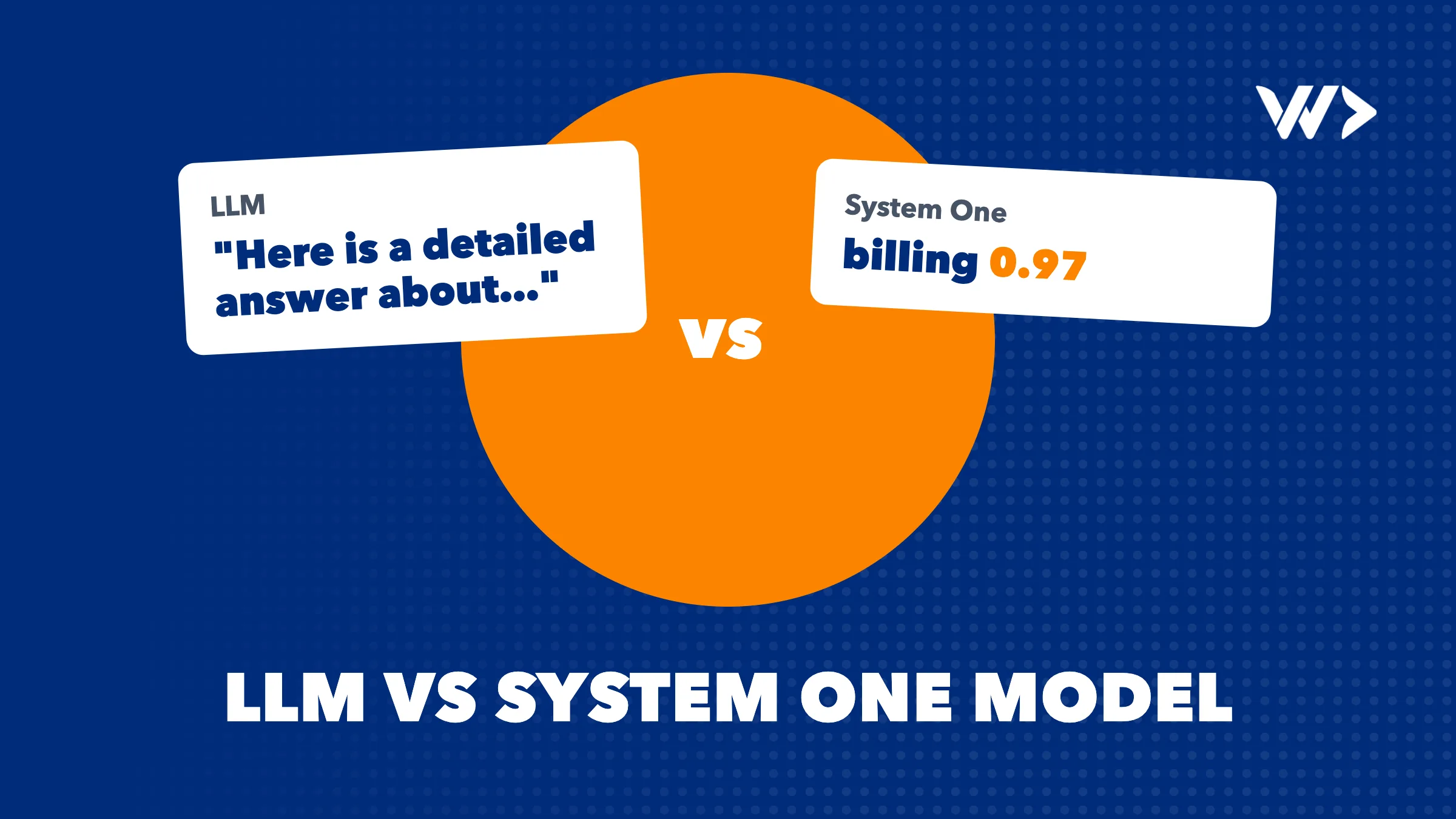
Most people now know what a large language model is: you ask Claude or ChatGPT something, and it writes an answer. In September and October 2026 a different kind of model arrived: the decision model, or "System One" model, with TypeSafe's Jev and Subquadratic's SubQ Snap as the first examples. They don't write anything. They pick an answer. That sounds like a small difference, but for software that has to make thousands of small decisions a day, it changes speed, cost and reliability. This article explains the difference, and when to use which.
The short answer
An LLM generates text: replies, summaries, code, explanations. A System One model makes a structured decision: it chooses from options you define, gives a score on a scale, or answers yes or no, each with a probability. You use an LLM when the output is open-ended. You use a decision model when the possible answers are known in advance and you need them fast, cheap and in a form your code can use directly. In many products the best setup uses both.
What an LLM does
A large language model such as Claude or ChatGPT predicts text, token by token. That makes it extremely flexible: it can write an email, explain a contract, draft code or reason through a problem step by step. The flip side is that every answer is generated text. If your software only needs to know "is this a billing question or a technical one?", you still pay for and wait on a generated reply, and then have to parse it.
What a System One model does
TypeSafe describes System One models as "a class of AI models built to make fast, structured decisions that software can use directly". Instead of writing a reply, the model reads your input and returns a typed answer with a probability. Jev offers three primitives:
- Choice: which option applies, for example which team should handle a ticket.
- Score: where the input falls on a scale you define.
- Noul: how likely a yes/no statement is true.
SubQ Snap works the same way: it picks from a predefined set of answers rather than generating text, and Subquadratic aims it at decisions inside AI agents, such as which file is relevant, which tool to use, whether a check passed, and when to stop or escalate.
The name comes from Daniel Kahneman's "System 1": the fast, intuitive mode of thinking, as opposed to the slow, deliberate "System 2". A decision model handles the quick judgments; a reasoning LLM handles the thinking.
Side by side
| LLM (e.g. Claude, ChatGPT) | Jev (TypeSafe) | SubQ Snap (Subquadratic) | |
|---|---|---|---|
| Output | Generated text, code, explanations | Choice, score or yes/no, with probabilities | A choice from predefined answers |
| Input | Text, and for many models images and files | Text and JSON only | Text and images |
| Context | Differs per model | 64k tokens per request, 32k per question | Up to 384k tokens in one call |
| Price (as of October 2026) | Example: Claude Opus 5.5 at $4 per million input and $20 per million output tokens | $0.042 per million input tokens, output free | $0.05 per million input tokens, output free |
| Explains its reasoning | Yes | No | No |
| Availability | Generally available | Production (jev-1.13), preview of 1.14 from 14 October 2026 | Public preview, limited capacity |
| Best for | Writing, reasoning, open-ended tasks | High-volume routing, guardrails and scoring | Decisions over long documents and agent steps |
The price difference is the striking part: per million input tokens, these decision models cost around a hundredth of a large frontier LLM, and they don't charge for output at all. For a single decision that hardly matters. For millions of decisions a month, it is the difference between a rounding error and a real line item.
How they work together
A decision model is not a replacement for an LLM. It is a filter in front of it. A typical setup for customer support:
- A decision model reads each incoming message and decides: billing, technical, sales or spam? Urgent or not?
- Simple, confident cases are routed automatically by your own code.
- Cases where the model is uncertain, or where a written reply is needed, go to an LLM or to a person.
The same pattern works inside AI agents: let the decision model pick the tool, check the result and decide whether to stop, and call the expensive reasoning model only for the steps that really need it. That is exactly the role both TypeSafe and Subquadratic describe for their models.
Jev or SubQ Snap?
Both are hosted APIs that return decisions and charge only for input. The main differences, from the vendors' own pages:
- Context: Snap reads up to 384k tokens of text and images in one call; Jev takes 64k per request, text and JSON only.
- Benchmarks: Subquadratic reports that Snap scores 61.7 against Jev's 57.9 on Decision Index 0.2.1, and leads on 13 of 16 enterprise benchmarks, while Jev stays ahead on some tool-use tasks. These are the vendor's own numbers on benchmarks it chose.
- Maturity: Jev has a production version; Snap is in public preview with limited capacity.
If your decisions are about short inputs such as messages, tickets or form fields, Jev is the more established choice. If they involve long documents, contracts or screenshots, Snap is built for that.
When to use which
- Use an LLM when the answer is open-ended: writing, summarising, explaining, coding, or reasoning through something new.
- Use a decision model when you can list the possible answers in advance, you need many decisions quickly and cheaply, and your code acts on the result.
- Use both when you want speed and low cost for the bulk of cases, and the depth of an LLM for the hard ones.
What to watch out for
- It's very new. Both models launched in the last weeks; versions, prices and benchmarks will change.
- Vendor numbers are vendor numbers. Test on your own data before you trust a benchmark.
- Probabilities are not guarantees. TypeSafe itself notes that calibration is measured across groups of predictions and does not guarantee that an individual answer is correct. Design an escalation path for uncertain cases.
- No explanations. A decision model tells you what, not why. Where you need an audit trail in plain language, keep an LLM or a person in the loop.
Where to start
Look for the decisions your product or team makes over and over: routing messages, flagging risky content, checking whether a document is complete. Those are the first candidates for a decision model. If you want help picking the right model and building it into your software, see our AI development work, or read more about what AI development involves and what AI really costs.
Sources
Frequently asked questions
What is a System One model?
A model that makes fast, structured decisions for software: it returns a choice, a score or a yes/no answer with a probability instead of generated text. The name comes from Kahneman's fast, intuitive System 1 thinking.
What is the difference between an LLM and a decision model?
An LLM like Claude or ChatGPT writes open-ended text, code and explanations. A decision model like Jev or SubQ Snap only picks from answers you define, which makes it faster and cheaper for routing, scoring and checks.
What do Jev and SubQ Snap cost?
As of October 2026, Jev costs $0.042 per million input tokens and SubQ Snap $0.05 per million input tokens. Neither charges for output tokens.
Is SubQ Snap better than Jev?
Subquadratic reports higher scores for Snap on most of its chosen benchmarks and a much larger context (384k vs 64k tokens), but Jev has a production version while Snap is in public preview. Test both on your own data.
Can a decision model replace ChatGPT or Claude?
No. It replaces the LLM only for bounded decisions. For writing, explaining, coding and reasoning, you still need an LLM; the two work best together.
Related articles
Is My Vibe-Coded Product Ready for Real Users? A Launch Checklist
Built your product with Lovable, Bolt, Cursor or Claude? Check secrets, data access, payments, backups, monitoring, privacy and code ownership before you launch.

.NET vs. Java in 2026: Here we go again
.NET 10 vs Java 25 in October 2026: versions, support dates, concurrency, memory, frameworks, and rules of thumb for choosing a platform.


Python vs Node.js in 2026: Which One Should You Use?
Python vs Node.js compared for 2026: ecosystems, performance, AI, TypeScript support, current versions, a comparison table and clear rules for choosing.