AI Foundations for Business: LLMs, RAG, Agents and Fine-Tuning Explained


At We Do Dev Work, we're not just using AI (to write blog posts), we're building with it every day. But the vocabulary is crowded with buzzwords, and it is hard to tell which ones matter for a business. This guide is for founders, product managers, developers and curious minds who want to understand the real building blocks of modern AI systems, and which one to reach for first.
If you want the one-paragraph version: most business AI work today means taking an existing language model and giving it your information (RAG) and, sometimes, the ability to act (agents). Retraining a model (fine-tuning) is the exception, not the starting point.
Key terms at a glance
| Term | Plain meaning | Good for | Watch out for |
|---|---|---|---|
| Machine learning | Software that learns patterns from data instead of following hand-written rules. | Predictions and classification: forecasting demand, flagging fraud, sorting tickets. | Needs good, relevant data. Output is a probability, not a guarantee. |
| LLM (large language model) | A machine learning model trained on huge amounts of text that can read and write language. | Drafting, summarizing, answering questions, extracting data from messy text. | It can state wrong things confidently, and it only knows what it was trained on plus what you give it. |
| Prompt engineering | Writing clear instructions and examples so the model gives useful output. | The cheapest first step. Often enough for simple tasks. | Results can vary; test prompts on real examples, not one lucky try. |
| Embeddings and vector databases | Text turned into numbers that capture meaning, stored so you can search by meaning rather than exact words. | Search over your own documents, finding similar items, recommendations. | Search quality depends on how documents are split and kept up to date. |
| RAG (retrieval-augmented generation) | Look up relevant passages from your documents first, then give them to the LLM to answer from. | Support bots, internal knowledge search, answers that must follow your policies. | If the right document is not found, the answer will be poor. Needs tidy source content. |
| AI agents | Systems where an LLM decides on steps and uses tools (search, calendar, database, email) to reach a goal. | Multi-step work: triaging requests, preparing reports, updating records. | More moving parts, more ways to fail. Keep a human approving anything risky. |
| Fine-tuning | Further training a base model on your own examples to change how it behaves. | A consistent tone or output format, or a narrow task done at scale. | Needs quality training data and effort, and the result is frozen until you retrain. |
| Multimodal AI | Models that handle images, audio or video as well as text. | Reading invoices and screenshots, transcribing calls, describing product photos. | Check accuracy on your own files, not on demos. |
Machine learning, the umbrella
Machine learning is the broad field. A model learns from examples and then applies what it learned to new data. Spam filters, demand forecasts and recommendation lists are all machine learning, and they existed long before chatbots. When someone says "AI" in a business meeting, ask whether they mean this older kind (predicting a number or a label from your data) or the newer language-model kind (producing text). They solve different problems and need different data.
Large Language Models (LLMs)
LLMs are the engines behind tools like ChatGPT, Claude and Gemini, and open models such as Llama, Mistral and DeepSeek. They are trained on enormous amounts of text to generate human-like language.
Example use case: Writing assistance, summarizing reports, answering customer questions.
Think of LLMs as the general-purpose brain capable of answering and generating text based on patterns it has learned.
What that means for a business: an LLM is excellent at language work and unreliable as a source of truth. It does not know your prices, your contracts or last week's decisions unless you give them to it. That gap is what the next sections address.
Prompt Engineering
Prompt engineering is about crafting inputs to get better outputs from an LLM. It can dramatically affect results, and it costs almost nothing to try.
Example use case: Rewriting a vague prompt like "Write about marketing" to "Write a 3-paragraph summary of modern B2B marketing trends using persuasive language."
Great prompts = great results. Good prompts = uncertain results.
Embeddings and Vector Databases
An embedding converts text into a vector (a list of numbers) that represents its meaning. This lets computers compare meaning, not just exact words. Once you have embeddings, you need a place to store and query them. That is where vector databases like Pinecone, Weaviate, or pgvector (used in our beloved Supabase) come in.
Example use case: Searching a knowledge base for similar documents even if different words are used, so your chatbot can find the right internal document.
Embeddings and vector DBs make AI apps "aware" of your custom data.
Retrieval-Augmented Generation (RAG)
RAG is a technique that retrieves relevant documents using embeddings and passes them to the LLM before it generates a response. The model answers from your material instead of from memory, and you can show which document an answer came from.
Example use case: A customer support chatbot that pulls policies from your company handbook before replying.
RAG is usually more flexible and cheaper than fine-tuning, because updating the answer means updating a document, not retraining a model.
AI Agents
Agents are systems that use LLMs to take actions. Unlike a passive chatbot, an agent can reason about a goal, remember context, call tools and chain multiple steps together.
Example use case: A virtual assistant that schedules your week by reading your calendar, booking travel, and sending reminders.
An agent is not just chat; it can do things based on the output of the LLM.
The more an agent can do, the more careful you need to be. Give it the narrowest permissions that work, log what it does, and put a person in the loop for anything that spends money, deletes data or contacts customers.
Fine-Tuning
Fine-tuning takes a base LLM and trains it further on your own examples. It creates a new model version specific to your use case, for example one that consistently writes in your tone of voice.
Example use case: A model trained on your past support replies so it answers in your house style and format.
Fine-tuning is powerful but resource-heavy and static.
A common mistake is fine-tuning to teach a model facts. Facts change, and a fine-tuned model will not know about them until you retrain. Use RAG for knowledge and keep fine-tuning for behavior and style.
Multimodal AI
Some AI systems handle not just text but also images, audio and video: speech to text, text to image, reading a screenshot or a scanned invoice.
Example use case: An AI that analyzes screenshots, transcribes audio, or pulls line items out of a photographed receipt.
Open Source vs. Closed Models
Open-weight models (like Llama, Mistral and DeepSeek) can be downloaded, hosted by you and adapted. Closed models (like those from OpenAI, Anthropic and Google) are used through an API and cannot be modified, though many can be customized through prompts and, in some cases, vendor fine-tuning.
Example use case: Hosting your own model when data must stay on your servers, versus calling an API when you want the strongest model with the least setup.
Open = control and flexibility, but you run it. Closed = convenience and capability, but you depend on a vendor.
Note that "lower cost" is not automatic with open models: you pay for servers and the people who run them. We cover real running costs in The cost is not zero.
Which one do you need? Rules of thumb
- Answers from your documents: start with RAG.
- Predict or classify from your own numbers (churn, demand, fraud): classic machine learning, not an LLM.
- Drafting, summarizing, extracting from text: an LLM with a good prompt, no extra tech.
- Work that spans several systems and steps: an agent, with human approval on risky steps.
- Consistent voice, format or a narrow high-volume task: consider fine-tuning, after prompts and RAG fall short.
- Sensitive data that cannot leave your infrastructure: look at open models you host, or vendor terms that fit your compliance needs.
How to start
- Pick one concrete problem. Something repetitive, text-heavy and painful, such as answering the same support questions or summarizing long documents. Avoid "add AI to everything".
- Check your data. Are the documents current, findable and allowed to be used? Messy sources produce messy answers.
- Prototype with an existing model and prompts. Try real examples from your own work, including the awkward ones.
- Add RAG if it needs your knowledge, then an agent only if it must take actions. Fine-tune last.
- Measure against a baseline. Compare quality and time saved with how the work is done today, and keep a person reviewing output at first.
- Plan for running costs and risk: usage fees, monitoring, and what happens when the model is wrong. See The cost is not zero.
For the wider picture, read What is AI development? and how AI changed software development. If you want help scoping a first project, see our AI development service or pricing.
Final Thought
Understanding these concepts helps you see AI not as magic, but as a toolbox. A toolbox that can help you engineer better solutions for your company or clients. The future belongs to those who can put the pieces together, starting small and measuring honestly.
Want to build with this tech? Let's talk. At We Do Dev Work, we help companies turn AI tools into practical, scalable solutions.
Not every AI task needs a large language model. For fast, structured decisions such as routing or scoring, read LLM vs System One models.
Frequently asked questions
What is the difference between machine learning and an LLM?
Machine learning is the broad field of software that learns from data. An LLM is one kind of machine learning model, trained on text to read and write language.
What is RAG in simple terms?
RAG looks up relevant passages from your own documents first and gives them to the LLM, so it answers from your material instead of from memory.
Should I use RAG or fine-tuning?
Use RAG when the model needs your knowledge, since updating a document is easier than retraining. Consider fine-tuning only for consistent style, format or a narrow task.
What is an AI agent and how is it different from a chatbot?
A chatbot replies with text. An agent uses an LLM to plan steps and call tools, such as a calendar or database, to complete a task.
Do I need my own model to use AI in my business?
Usually not. Most business uses start with an existing model through an API, adding your data with RAG. Hosting an open model matters mainly for strict data control.
How do I start with AI in my company?
Pick one repetitive, text-heavy problem, check your data, prototype with an existing model, and measure the result against how the work is done today.
Related articles
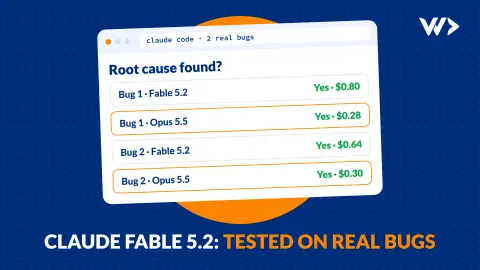
Claude Fable 5.2 Tested on Two Real Bugs: Is It Worth It?
Claude Fable 5.2 launched on 9 Nov 2026. We gave it and Opus 5.5 two real bugs from our own site: both found the cause, Opus at less than half the cost.

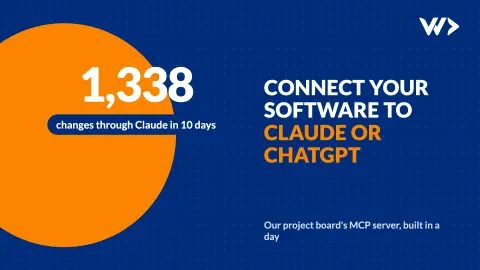
Connect Your Software to Claude or ChatGPT: What an MCP Server Takes
An MCP server lets Claude or ChatGPT read and update your own software. We built one for our project board in a day: 1,338 changes in its first 10 days. How it works and what to get right.
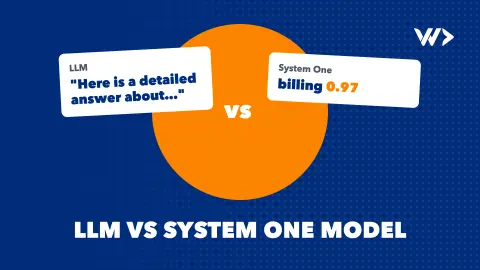
LLM vs System One Model: Claude and ChatGPT vs Jev and SubQ Snap
LLMs like Claude and ChatGPT write answers; System One decision models like Jev and SubQ Snap pick them. The difference, prices and when to use which.