Claude Fable 5.2 Tested on Two Real Bugs: Is It Worth It?

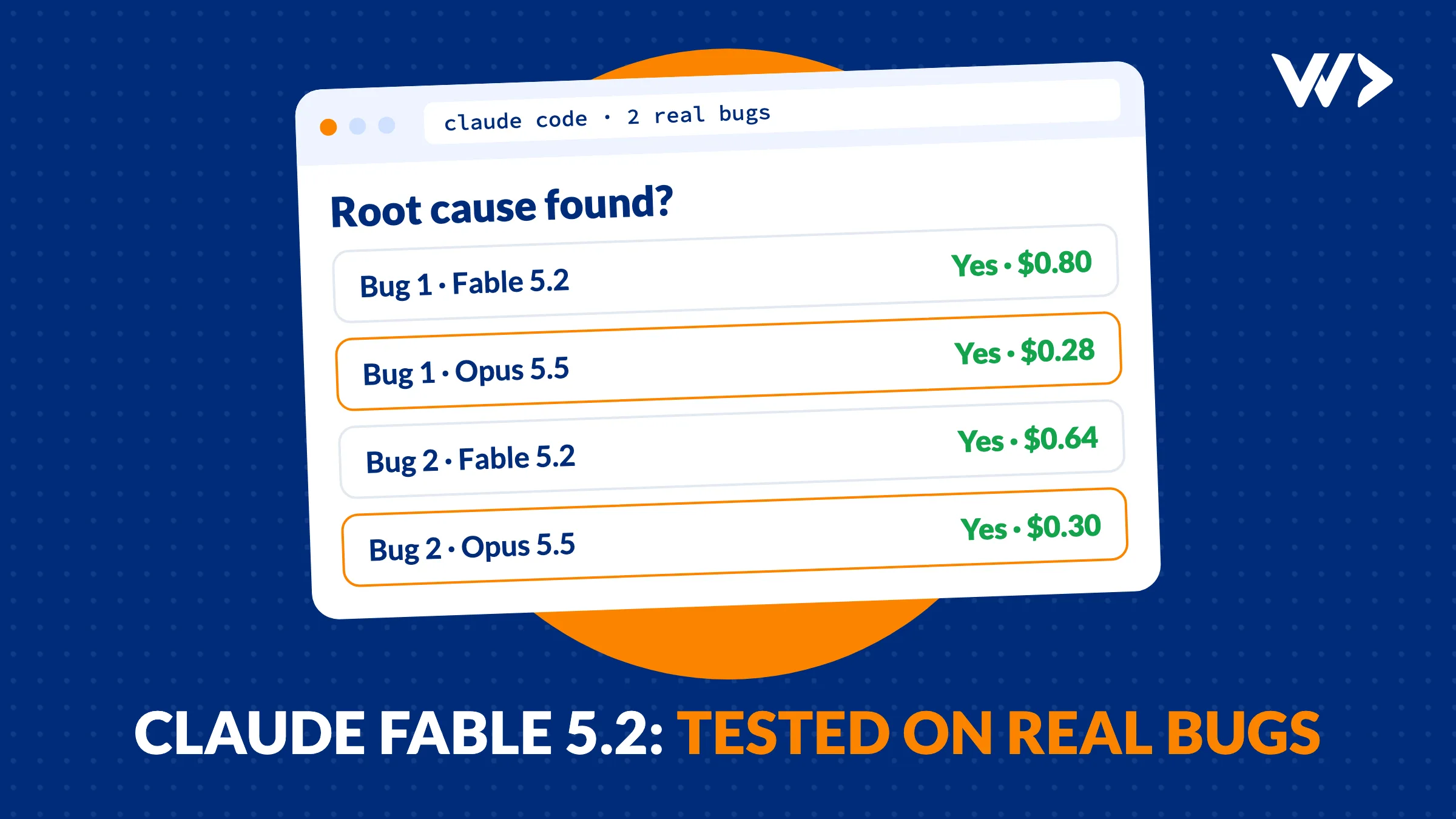
Short answer: Claude Fable 5.2, released by Anthropic on 9 November 2026, is the strongest Claude model you can use today for hard technical work, and it is 20% cheaper than Fable 5.1. Per token it still costs twice as much as Claude Opus 5.5. On 11 November we gave both models two real bugs from our own website, wedodevwork.com. Both found the root cause of both bugs. Opus 5.5 did it for less than half the money. For everyday development work, Opus 5.5 is the better buy; keep Fable 5.2 for the problems where Opus gets stuck. Anthropic gives the same advice.
What is new in Claude Fable 5.2
Fable 5.2 and Mythos 5.2 came out on Monday 9 November 2026. Mythos 5.2 is the same underlying model with looser cybersecurity and biology safeguards, and only vetted organisations can use it. Fable 5.2 is open to everyone on a paid plan and on the API. What matters if you pay for it:
Price: $8 per million input tokens and $40 per million output tokens, down from $10 and $50 for Fable 5.1. Opus 5.5 costs $4 and $20.
Speed: Anthropic says answers come up to 30% faster than with Fable 5.1. A fast mode is up to 2.5 times faster and costs $16 and $80 per million tokens.
Where: the Claude apps on the Pro (paid with usage credits), Max, Ultra, Team and Enterprise plans, the Claude API as
claude-fable-5-2, Amazon Web Services, Google Cloud, Microsoft Foundry and Claude Code.Safeguards: cybersecurity and biology questions that the safeguards flag are answered by a less capable model instead. If your legitimate security work is affected, Anthropic has a Cyber Verification Program.
Data: by default Anthropic keeps data for 30 days for safety monitoring. Eligible customers can use it with zero data retention.
On Anthropic's own benchmarks, Fable 5.2 scores 69.9% on FrontierSWE v2 (agentic coding), against 56.3% for Fable 5.1 and 62.3% for Opus 5.5. On AutomationBench, a business workflow test, it scores 51.4% against 42.5% for Opus 5.5. Those are the vendor's numbers. We wanted to see what it does with our own code.
Our test: two bugs we fixed on our own site
We picked two bugs we had already fixed in the code of wedodevwork.com, so we knew the right answer. For each bug we exported the code as it was the moment before our fix, without the git history, so the fix and our commit message were not there to find. Each model got the same short bug report, the same copy of the code and read-only access: it could read and search files, not run anything or change anything. We ran both in Claude Code on 11 November 2026, one run per model per bug.
Bug 1, from 4 November: our blog posts listed only their own language in the hreflang tags, the tags that tell Google which page is the Dutch, French or Thai version. The page looked perfect; only the HTML source showed it. We described the cause in 5 multilingual SEO mistakes we found on our own site.
Bug 2, from 1 November: after a short database maintenance window, every Thai, Dutch, French and German URL redirected to a broken English address, while the database was healthy again. A real outage on our live site.
| Bug | Model | Root cause found | Time | Cost |
|---|---|---|---|---|
| 1: hreflang on blog posts | Fable 5.2 | Yes | 30 seconds | $0.80 |
| 1: hreflang on blog posts | Opus 5.5 | Yes | 24 seconds | $0.28 |
| 2: language URLs broken after maintenance | Fable 5.2 | Yes | 35 seconds | $0.64 |
| 2: language URLs broken after maintenance | Opus 5.5 | Yes | 44 seconds | $0.30 |
Cost is what Claude Code reported for each run at API prices. The two models together cost us $2.02 for four runs.
What the answers looked like
Bug 1. Both models named the same file and line we had fixed: the blog page returned a list of its translations under the name languages, which replaced the site-wide list that our SEO component reads. Both proposed renaming that one key, which is exactly what we did. Each also spotted a side effect we had not written down: Fable 5.2 noticed that the language switcher read the same broken list on blog pages, and Opus 5.5 noticed that the currency lookup did too.
Bug 2. Both found the line where the site cached its list of languages. When the database query failed during maintenance, the code fell back to "English only" and kept that answer in memory until the server restarted. Both explained why it survived the database coming back, and both gave the same way to recover right now: redeploy, then clear the CDN cache.
Then something we had not expected: both proposed a better fix than the one we shipped. Our fix on 1 November stopped caching the bad answer, but during an outage it still falls back to English only, so visitors are still sent the wrong way for as long as the database is down. Both models suggested a fixed list of our five languages as the fallback, so nobody is misrouted at all. Opus 5.5 went one step further and pointed out that our language redirect is a permanent 301, which browsers keep, and should not be cached.
Two bugs and one run each is not a benchmark. Both bugs were the kind an experienced developer finds in an hour: one file, one clear symptom. That is exactly the point. Most bugs in a business's software look like this, and on that kind of work the cheaper model was just as good.
Which Claude model for which job
| Work | Model we would pick | Price per million tokens (input / output) |
|---|---|---|
| Bugs, features, code review, everyday development | Opus 5.5 | $4 / $20 |
| Long, ambiguous technical work, research, problems where Opus gets stuck | Fable 5.2 | $8 / $40 |
| The same task many times a day: sorting, extracting, short answers in your own product | Sonnet 5.5 or Haiku 5.5 | $2 / $10 and $0.10 / $0.50 |
Anthropic itself recommends Opus 5.5 for most coding and knowledge work and describes Fable 5.2 as the model for hard problems in engineering, mathematics and science. Our test agrees for the everyday part. Where Fable 5.2 earns its price is the work we did not test: long jobs with many steps, where a better model makes fewer wrong turns.
What this means if you build software with AI
The model cost is rarely the expensive part. Four runs cost $2.02; a senior developer reading the answer, checking it against the code and testing the fix costs far more, and that step is not optional. Both models said, correctly, that they had worked from the code only and had not run anything. A model that sounds sure is not the same as a fix that works.
That is how we use Claude ourselves. Our own Claude sessions pick up tickets on our team board and report back there, and a developer reviews every change before it goes live. For how to connect your own software to Claude, read connect your software to Claude or ChatGPT. If an AI tool built your product and you are not sure it is ready for real customers, read is my vibe-coded product ready. And if you are weighing a custom tool against a subscription, build or buy software shows how AI changed that calculation.
Want us to look at your code?
Our senior developers work with these models every day and review what they produce. A bug like the two above usually takes a few hours to find, fix and test, which you can pay by the hour or from a strip card of 14 hours ($1,050). For a larger build, see our projects, or contact us with what you have.
Frequently asked questions
When was Claude Fable 5.2 released?
Anthropic released Claude Fable 5.2 and Claude Mythos 5.2 on Monday 9 November 2026.
How much does Claude Fable 5.2 cost?
On the API, $8 per million input tokens and $40 per million output tokens, 20% less than Fable 5.1. Fast mode costs $16 and $80. In the Claude apps it is part of the Pro (with usage credits), Max, Ultra, Team and Enterprise plans.
Is Claude Fable 5.2 better than Opus 5.5 for coding?
On Anthropic's benchmarks it scores higher. In our test on two real, everyday bugs, both found the root cause and Opus 5.5 cost less than half, so for routine work we would pick Opus 5.5.
What is the difference between Fable 5.2 and Mythos 5.2?
They share the same underlying model. Mythos 5.2 has looser cybersecurity and biology safeguards and is only available to vetted organisations; Fable 5.2 is available to everyone.
Can I use Claude Fable 5.2 in Claude Code?
Yes. It is available in Claude Code and on the API as claude-fable-5-2, including a faster mode at a higher price.
Can an AI model fix bugs without a developer?
It can often find the cause, as both models did in our test. A developer still needs to check the answer against the code, test the fix and decide whether it is safe to release.
Related articles
Custom Web Application Development: Cost, Process and What Goes Wrong (2026)
What does a custom web application cost, how is it built and where does it go wrong? Day rates, a worked example and two real projects: Waterleau and RAS Security.

Connect Your Software to Claude or ChatGPT: What an MCP Server Takes
An MCP server lets Claude or ChatGPT read and update your own software. We built one for our project board in a day: 1,338 changes in its first 10 days. How it works and what to get right.

Developer Disappeared? How to Get Your Site and Code Back
Your web developer stopped responding or the agency went bust. How to recover your domain, hosting, code and app store accounts, and who can take over.