WordPress or Strapi in 2026: Which Works Better With AI?

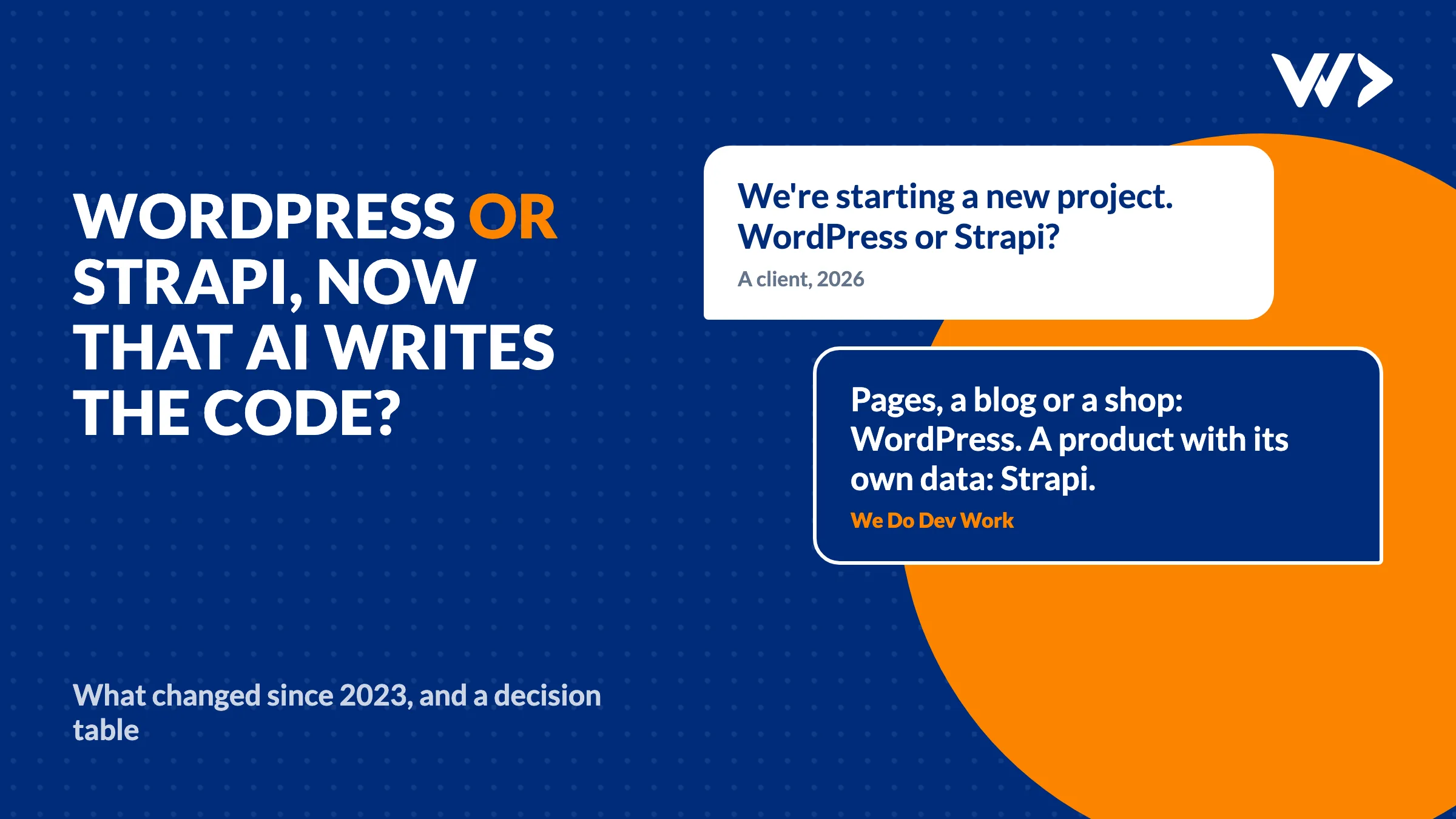
Short answer: if your site is mostly pages, a blog or a WooCommerce shop and the people editing it already know WordPress, stay on WordPress: AI makes it cheaper to maintain, not obsolete. If you are building a product with its own data (listings, profiles, events, reviews) and a separate front end, choose Strapi or another code-first setup: AI tools work much better when everything that defines the system lives as code in one repository. In 2023 we wrote a Strapi vs WordPress comparison on Medium. Most of it still holds. What changed is who writes the code.
What changed since 2023
In 2023 the question was: which CMS is easier for your team? In 2026 a large part of the code on a project is written by AI tools such as Claude Code, Cursor or Lovable, with a developer reviewing it. That adds a second question: which system can AI read, change and test safely?
An AI tool is only as good as what it can see. It reads files, runs commands and checks the result. Anything that lives outside the code (a setting someone clicked in an admin panel, a layout stored in the database, a plugin nobody has read) is invisible to it until someone exports or explains it. That single difference decides most of this comparison.
Why Strapi fits AI-assisted development
In Strapi, every content type is a file in your project: src/api/[name]/content-types/[name]/schema.json describes its fields and relations. Since Strapi 5 (September 2024) the codebase is TypeScript. For an AI tool that means:
It sees the whole data model. Ask it to add a "release date" field to games and it edits the schema, the API code and the front end in one change.
Every change shows up in review. A new field is a diff in Git, not a click in production that nobody remembers.
It can test before anything goes live. The same repository runs on a laptop or a staging server, so the AI and the developer check the change there first.
Agents can manage content too. Strapi's own MCP server lets AI agents create and edit content, and since version 5.52 (August 2026) those agent edits can show up in the audit log next to human ones.
A real example: we built Funjible Games, a gaming platform with game reviews, news, guides, events and guilds, on Strapi with a Next.js front end. A site like that is mostly structured data with relations between games, articles and events. In WordPress you would bend posts and custom fields until they fit. In Strapi each of those is its own content type, and the front end asks the API for exactly what a page needs.
Where WordPress struggles with AI
WordPress powers about 4 in 10 websites, so AI tools know it very well. The problem is not knowledge, it is visibility:
Configuration lives in the database. Theme settings, plugin options and many page builder layouts are stored in database tables, not in files. An AI tool working on the code cannot see them, and a change in the admin panel is not in version control.
The plugin mix is the real system. A typical site combines many plugins written by different people. The AI can read their code, but nobody planned how they work together.
Testing is harder. To test a change properly you need a copy of the database and the uploads, not just the code.
WordPress is catching up. Version 6.9 added the Abilities API, and the official MCP Adapter plugin (announced in February 2026) lets AI agents discover and run functions on a site. That helps agents that manage content. It does not move the configuration into code.
Where WordPress still wins
None of this makes WordPress the wrong choice. It still wins when:
The site is mostly pages and posts. A company site, a blog or a portfolio needs no separate front end and no API.
You sell with WooCommerce and want payments, shipping and invoices from plugins instead of custom code.
Editors already know it. Retraining a marketing team costs more than the hosting.
Budget is small. A theme plus a few good plugins is the cheapest way to get a decent site online.
AI also makes WordPress cheaper to run. We maintain 50+ WordPress sites for a design agency in Rotterdam for about 10 hours a month. When the PHP2Shell vulnerability was published in October 2026, we acted on all of them within minutes. Read how that portfolio is maintained and what to do about PHP2Shell.
A third option: no ready-made CMS at all
With AI writing most of the admin screens, a ready-made CMS is no longer the only way to edit content. Our own website, wedodevwork.com, runs on SvelteKit with Supabase as the database. The editing screens are a small admin app we built with Lovable on top of the same database. Every table, access rule and page is code that AI tools can read, and we publish blog posts in five languages straight from scripts.
This only makes sense if a developer looks after it. For a company that wants to edit its own pages without help, WordPress or Strapi is still the better choice. More on that setup: Supabase vs Firebase and how we use Lovable and Claude together.
What we would correct in our 2023 article
Speed. We said Strapi is faster because Node.js is faster than PHP. In practice the speed a visitor feels depends far more on caching, images and the front end than on the CMS language. A cached WordPress page is fast; a badly built Next.js page is slow.
MongoDB. We suggested Strapi with MongoDB. Strapi dropped MongoDB with version 4 in 2021; today it runs on PostgreSQL, MySQL, MariaDB or SQLite. We use PostgreSQL.
"Strapi is the clear winner". Too strong. Strapi wins for products with their own data. For a company site, WordPress is often the better and cheaper answer.
How to choose: decision table
| Your situation | Best fit | Why |
|---|---|---|
| Company site, blog or portfolio, edited by non-developers | WordPress | Editors know it, cheapest to build |
| Webshop with standard payments and shipping | WordPress + WooCommerce (or Shopify) | Plugins instead of custom code |
| Platform with its own data: listings, profiles, events, reviews | Strapi + Next.js or SvelteKit | Data model in code, AI can work on all of it |
| Same content on a website and a mobile app | Strapi | One API for every front end |
| Product built mostly with AI tools, with a developer in charge | Strapi, or a database like Supabase with your own admin | Everything in one repository |
| Existing WordPress site that works | Keep WordPress, maintain it properly | Moving costs more than it saves |
Moving from WordPress to Strapi?
Only do it when WordPress actually blocks you: when your data no longer fits posts and custom fields, or you need the same content in an app. A move means rebuilding the front end, mapping content types and redirecting every old URL, or you lose your Google rankings. If you are not sure, start with a short review of your current site. You can book a senior developer for a few hours with a strip card ($1,050 for 14 hours), or ask for a subscription from $550 a month if the work will continue.
Frequently asked questions
Is Strapi better than WordPress in 2026?
For products with their own data and a separate front end, yes: the data model is code, so developers and AI tools can change and test it safely. For company sites, blogs and WooCommerce shops edited by non-developers, WordPress is usually the better and cheaper choice.
Can AI tools like Claude Code work on a WordPress site?
Yes, they know WordPress well and can write themes and plugins. The limit is that settings, plugin options and many page builder layouts are stored in the database, so the AI cannot see or test them from the code alone.
Does Strapi support AI agents?
Yes. Strapi has its own MCP server that lets AI agents create and edit content, and since version 5.52 (August 2026) agent edits can be recorded in the audit log next to human edits.
Does WordPress support MCP?
WordPress 6.9 added the Abilities API, and the official MCP Adapter plugin, announced in February 2026, exposes those abilities to AI agents so they can discover and run functions on a site.
Should I move my WordPress site to Strapi?
Only if WordPress blocks you, for example when your data no longer fits posts and custom fields or you need the same content in an app. A move means a new front end, content mapping and redirects for every old URL.
Does Strapi still work with MongoDB?
No. Strapi dropped MongoDB support with version 4 in 2021. It runs on PostgreSQL, MySQL, MariaDB or SQLite.
Related articles
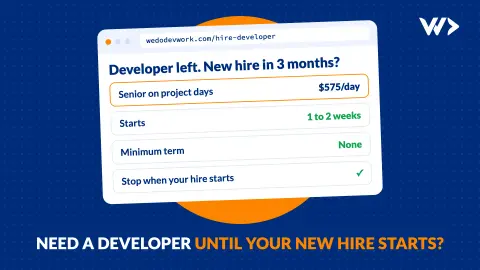
Need a Developer for a Few Months While You Recruit?
Your developer left and the new hire is months away. How to bridge the gap with a contract developer: timeline, what 3 or 6 months cost, and a clean handover.

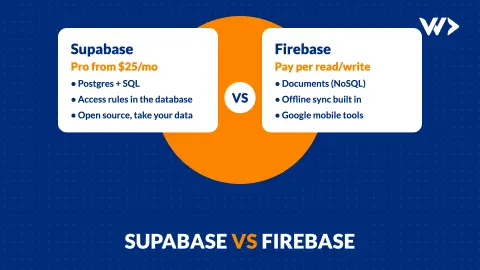
Supabase vs Firebase (2026): Which One for Your App?
Supabase or Firebase in 2026? A comparison from a team running three products on Supabase: data model, security, prices checked 19 Nov 2026, and how to choose.

Page Title Cut Off in Google? What We Fixed on 799 Pages
Google cut off 589 of our 799 page titles. How we found it, the one-line rule that fixed most of them, and four other site errors to check on your own site.