Supabase vs Firebase (2026): Which One for Your App?

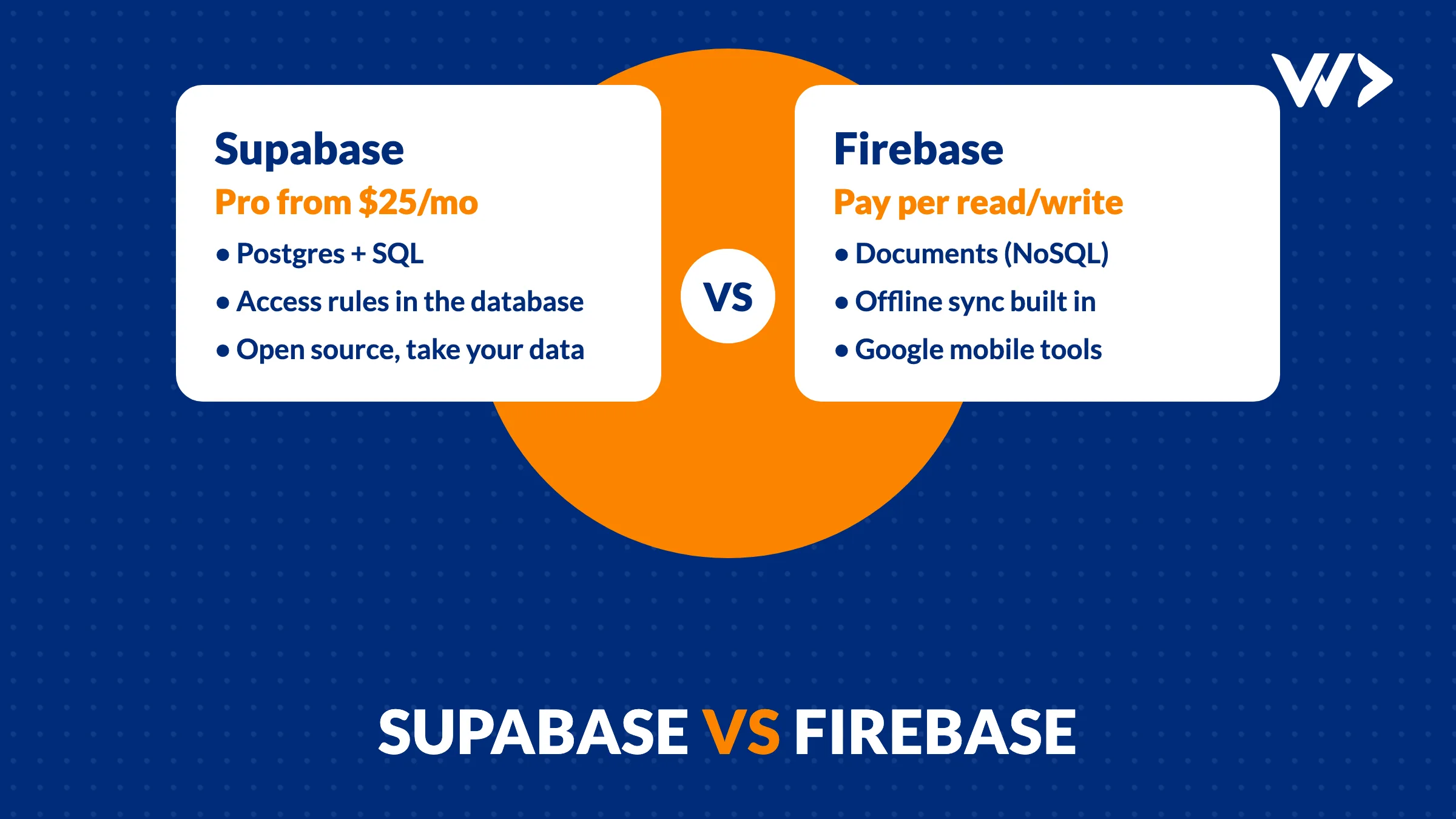
Short answer: choose Supabase when your data is relational (customers, orders, invoices, bookings), when you want plain SQL and a Postgres database you can take with you, and when you want access rules enforced in the database itself. Choose Firebase when you are building a mobile-first app that needs offline sync and live updates out of the box, or when your team already knows the Google ecosystem. Both have a free tier that is fine for a prototype and not for a business that needs to stay online. We run our own website, our project board and parts of Thairanked on Supabase; below is what that taught us, a side-by-side table, and prices checked on 19 November 2026.
What we run on Supabase ourselves
This is not a comparison from documentation alone. One Supabase project, on Postgres 17, carries three of our own products:
Our website, wedodevwork.com, in five languages: 79 tables, 142 row-level security policies, 422 blog translations and 437 files in storage.
Our project board, which our team and clients use every day: 97 tables of its own. Since 21 October 2026 its connector for Claude and ChatGPT has logged 8,687 writes. We described how we built that connector in connecting your software to Claude and ChatGPT.
Server-side functions for all of it: about 40 Edge Functions that send emails, generate share images, translate content and unlock private pages with a one-time code.
Three lessons from running that:
Row-level security is the best and the riskiest part. Access rules live in the database, so a bug in the app cannot leak another customer's data. But a table with security switched off is readable by anyone who has your public key, and that key is in every browser. Most leaks we see in apps built with AI tools start there; see is my vibe-coded product ready.
Private links need database functions, not only policies. For pages that open with a code (we have 24 such functions), a function that checks the code and returns only that one record is simpler and safer than a clever policy.
Files need a cache in front. Public files are served without a long cache by default. For images on a busy site, put a CDN or the image transformation service in front, or every visitor downloads them again.
Supabase vs Firebase side by side
| Supabase | Firebase | |
|---|---|---|
| Database | PostgreSQL: tables, relations, joins, SQL | Firestore: documents and collections (NoSQL); Postgres is available separately through Data Connect with Cloud SQL |
| Access rules | Row-level security policies in the database, written in SQL | Security Rules, a separate rules language per collection |
| Reports and queries | Any SQL query, views, functions | Filters, sorting and counts within a collection, no joins; heavier reporting usually means exporting to BigQuery |
| Live updates and offline | Realtime subscriptions; offline sync is up to you | Live listeners and offline persistence built into the mobile and web SDKs |
| Server code | Edge Functions (TypeScript on Deno) and database functions | Cloud Functions (Node.js or Python) |
| Mobile extras | Not included | Push messages, Crashlytics, Analytics, Remote Config in the same console |
| Open source and self-hosting | Open source; you can self-host, and a standard Postgres dump moves anywhere | Google-only service |
| How you pay | A plan per organisation, plus compute and usage | Per operation: document reads, writes and deletes, storage, function calls |
Prices, checked on 19 November 2026
From the vendors' own pricing pages (supabase.com/pricing, firebase.google.com/pricing):
Supabase Free: $0, 500 MB database, 50,000 monthly active users, 1 GB file storage, up to 2 active projects. Free projects are paused after one week without activity.
Supabase Pro: from $25 a month, with 8 GB database disk, 100,000 monthly active users, 100 GB file storage and $10 of compute credit, which covers one small instance. Each extra project pays for its own compute.
Firebase Spark (free): Firestore with 1 GiB stored data and, per day, 50,000 document reads, 20,000 writes and 20,000 deletes; Authentication up to 50,000 monthly active users.
Firebase Blaze: pay as you go at Google Cloud prices above those free amounts. Data Connect includes 250,000 operations a month, then $0.90 per million; the Cloud SQL Postgres instance behind it starts at about $9.37 a month.
The difference that matters is the model, not the starting price. Firestore charges per document read. A product list that reads 50 documents per page view uses 50 reads; at 1,000 views a day that is the entire free daily quota of 50,000 reads, from one page. On Supabase the same page is one SQL query, and you pay for the size of the server, not for each row it returns. Neither is always cheaper: Firebase is very cheap for small, spiky apps, and Supabase is easier to predict for apps with lots of reads and reports.
How to choose
Draw your data. If your main things point at each other (a customer has orders, an order has lines, a line has a product), you want a relational database. We explain how in starting your project with an ERD.
Is it mobile-first with offline use? Field apps, chat, apps used on bad connections: Firebase gives you offline sync without building it.
Will you need reports? Finance, stock, management dashboards: SQL makes them a query instead of a project.
Where must the data live? Both let you pick a region, including in the EU. Check the region of every service you use, not only the database.
Could you leave? A Postgres dump opens in any other Postgres host. Moving out of Firestore means rewriting the data layer.
What it costs to have it built
Most apps we build on Supabase start with a few days of data model and access rules before any screens, because that is where the cost of mistakes is highest. As a guide, a senior developer costs $575 a day and a lead developer $795 a day on a project, with weekly progress and your own repository. For a full picture of budgets, see custom web application development cost. Already running an app and worried about its security rules? A strip card of 14 hours for $1,050 is enough for a review of the policies and fixes to the worst ones, and if data is exposed right now, use emergency help.
Not sure which fits your app? Tell us what you are building and we will say which one we would choose, and why.
Frequently asked questions
Is Supabase better than Firebase?
Not in general. Supabase is the better fit for relational data, SQL and reports; Firebase is the better fit for mobile apps that need offline sync and Google's mobile tools.
Is Supabase cheaper than Firebase?
It depends on the app. Supabase charges per plan and server size, Firebase per operation. Apps with many reads or reports are usually easier to predict on Supabase; small, spiky apps can be very cheap on Firebase.
Can I use Supabase for a production business app?
Yes. We run our own website, project board and parts of Thairanked on one Supabase project. Use a paid plan for production, since free projects pause after a week without activity.
Does Firebase support SQL now?
Firebase Data Connect connects to a Cloud SQL for PostgreSQL database. Firestore itself remains a document database.
Can I move from Firebase to Supabase later?
Yes, but it is a project: documents must be mapped to tables, security rules rewritten as policies, and the app's data calls changed. Plan it rather than doing it in a rush.
Where are prices for Supabase and Firebase listed?
On supabase.com/pricing and firebase.google.com/pricing. The prices in this article were checked on 19 November 2026.
Related articles

Claude Fable 5.2 Tested on Two Real Bugs: Is It Worth It?
Claude Fable 5.2 launched on 9 Nov 2026. We gave it and Opus 5.5 two real bugs from our own site: both found the cause, Opus at less than half the cost.

PHP 8.2 End of Life on 31 December 2026: What to Do Now
PHP 8.2 gets no security fixes after 31 December 2026. Which version to move to, what breaks in WordPress or Laravel, and how to upgrade without downtime.
Proposals Clients Sign: Options, Versions and Online Signing
What we learned moving our proposals from PDFs to signed online pages: let clients choose options, keep versions, lock what was signed, know when it is read.