BD Isn’t Sales, It Starts Before the Sale

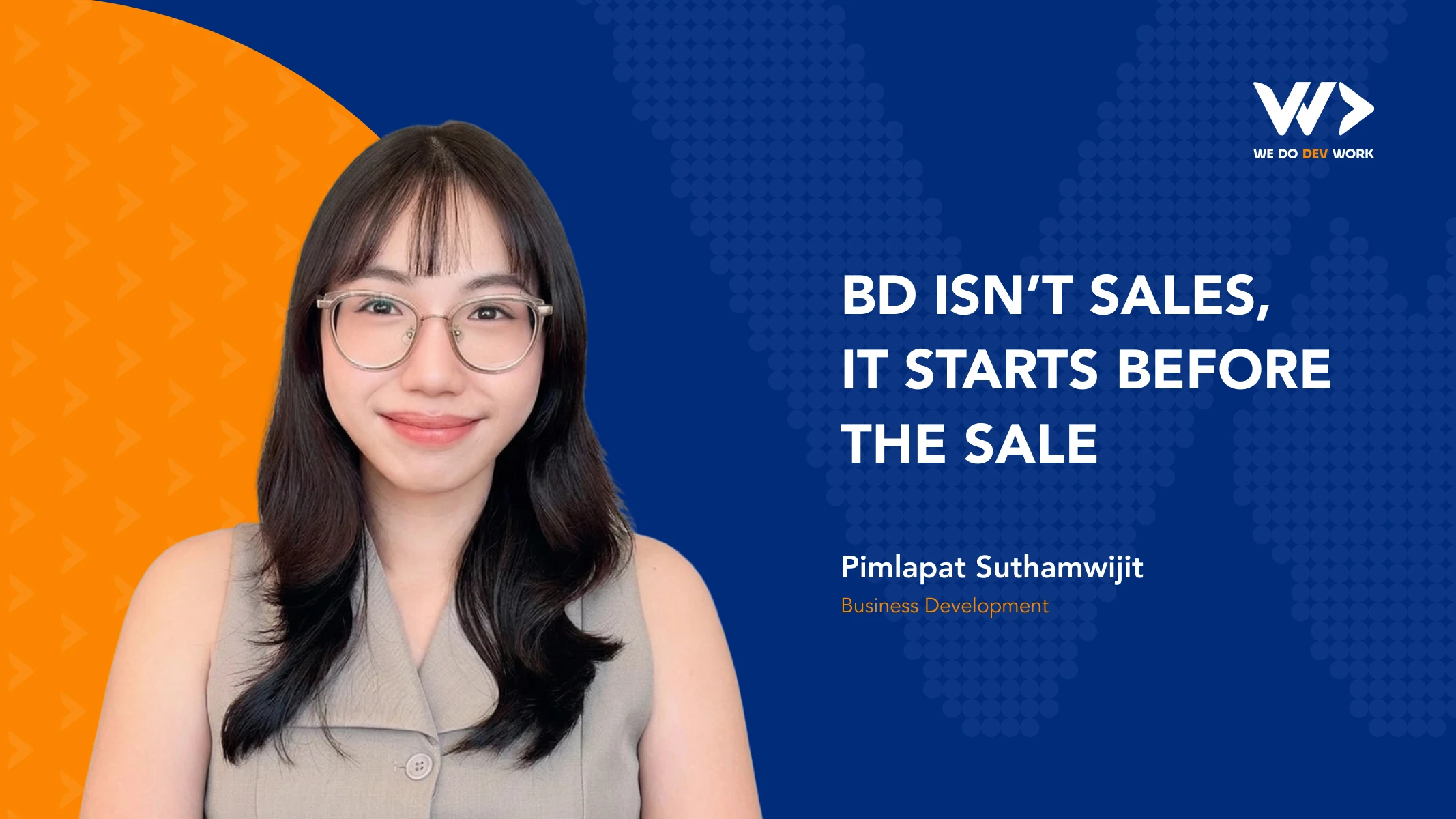
What I’m learning about business development as an entry-level BD at a software agency
When I first started in business development, I thought BD was basically another name for sales. Find potential clients, talk to them, follow up, and hopefully turn those conversations into business.
It sounded simple enough.
But after getting more involved at WDDW and speaking with founders, I realised there is more to it than that. Especially when you're working in software, the conversation often starts before there is anything to actually sell.
That is where I'm starting to see the difference between Sales and BD.
It Starts With Understanding the Problem
When a founder approaches a software agency, they don't always come with a clear plan. Sometimes they have an idea. Sometimes they have a business problem. Sometimes they simply know that something isn't working and think software might be the answer.
As a BD, I’m learning not to jump straight into the solution.
If someone says, “We want to build an app,” there are many questions we could ask about features, timeline and budget. But before those questions, I think it's more important to understand why they want the app in the first place.
The answer can change the whole conversation.
Maybe they need an app. Maybe they need a smaller MVP. Maybe they need to solve a process problem first. And sometimes, they may not need to build anything yet.
I'm learning that understanding the problem is often more important than understanding the feature list.
So, Is BD Really Different From Sales?
I’m still figuring this one out.
There is obviously a lot of overlap between BD and Sales. Both involve talking to potential clients, understanding their needs and creating business opportunities.
The way I currently see it is that Sales is more focused on turning an opportunity into a client, while BD starts earlier by figuring out whether there is a good opportunity to begin with.
At WDDW, this distinction matters because we aren't selling a fixed product. We're helping businesses build software that can become an important part of their operations or business model.
That means we need to understand more than just what someone wants us to build. We need to understand why they want to build it.
Building Software Isn't the Same as Solving a Problem
This is probably one of the biggest things I'm learning from working around software projects.
It is possible to build something successfully and still not solve the problem.
A product can work perfectly, but if customers don't need it, the business wasn't ready for it, or the scope was much bigger than necessary, then the project hasn't really created the value everyone hoped for.
That's why the conversations before development matter.
At WDDW, I'm seeing how the team looks beyond the initial request and thinks about what the business actually needs. Sometimes that means changing the scope. Sometimes it means starting smaller. And sometimes it means questioning whether something should be built at all.
For someone in BD, learning to recognise those situations is just as important as finding new opportunities.
Sometimes “No” Is a Better Conversation
This is something I didn't think much about when I first started.
When you're new to BD, it can be easy to think that a good opportunity is one that moves towards a proposal and eventually a deal.
But I'm learning that not every potential client is a good fit, and not every project is worth pursuing.
A founder might not be ready to build yet. They might need to validate the idea first. Or WDDW might simply not be the right partner for what they need.
Of course, saying no doesn't help the sales numbers in the short term. But if the project isn't going to create value for the client, pushing it forward doesn't really help anyone either.
For me, this is where the idea of trust starts to become more real. It is easy to say that a company values honesty. It is harder to turn down work when the opportunity is right in front of you.
What I'm Learning From BD at WDDW
I'm still new to business development, so I don't want to pretend that I've figured it all out.
What I'm learning is that I don't need to have every answer. I need to ask better questions, listen carefully and understand when someone else on the team needs to be involved.
I'm often one of the first people a founder speaks with, which means I have a responsibility to understand their business before passing the conversation further into the team.
The better I understand the problem, the better our team can understand what we're actually trying to solve.
When I started, I thought BD was mainly about getting closer to the sale. Now I think it is more about getting closer to understanding the opportunity first.
Is there a real problem? Is software the right solution? Is the timing right? And if WDDW can help, what would actually make sense to build?
I’m still learning the answers to those questions.
But that is also what I find interesting about BD at WDDW. I'm not just learning how to find clients. I'm learning how to understand businesses, ask better questions, and recognise where we can genuinely add value.
And maybe that is where BD starts, not with the sale, but with understanding whether there is something worth building together.
Related articles
.NET vs. Java in 2026: Here we go again
.NET vs. Java in 2026: Compare performance, concurrency, frameworks, memory management, and key differences to choose the right platform for your project.


Python vs Node.js: Which One Should You Use?
Python vs. Node.js: Compare their strengths, ecosystems, performance, AI capabilities, and use cases to choose the right backend technology for your project.

So, what's going on at WDDW?
A look at what’s been happening at We Do Dev Work: team growth, new AI and e-commerce projects, internal products, white-label partnerships, and building a company that’s becoming less dependent on its founder.

Ready to take your business to the next level.
Partner with a professional team that turn ideas into powerful business experiences and scales with your growth.