Supabase Launch Week 15: what matters to us


At We Do Dev Work, we often choose Supabase as our backend for custom software projects. From startup MVPs to scalable platforms, it allows us to move fast without cutting corners. That is why we always keep an eye on their launch weeks.
Here are the seven updates from LW15 that are the most relevant for our daily work. A more practical update, focused on scalability and surprisingly no AI novelties.
1. Improved security controls
Supabase introduced a new model for API keys and support for asymmetric JWTs (Elliptic Curve and RSA). The new structure separates Publishable and Secret keys, limits scope, and improves visibility.
As their team writes:
“The changes reduce the blast radius of compromised keys, improve observability, and align with how modern identity systems operate.” More on that here: https://supabase.com/blog/improved-security-controls
2. Algolia connector for Supabase
Supabase now offers a native integration with Algolia. This allows us to index project data directly and deliver performant, real-time search interfaces. No more middle-layer scripts or custom sync jobs. A practical solution we are already trying out on a large scale directory website.
3. OpenTelemetry support
Logs, traces, and metrics can now be exported to OTel-compatible tools. This fits neatly into how we already structure observability, and will be especially useful for production debugging and performance tracking.
4. Edge Functions with persistent storage and faster boot times
Edge Functions now support Deno 2.1 and persistent storage through S3-compatible mounting. Cold starts are up to 97 percent faster, making Supabase’s serverless functions more reliable for real-world usage.
5. Stripe to Postgres sync engine
Billing data can now be synced using a lightweight npm package, either inside Node.js apps or directly within Edge Functions. This is useful for financial dashboards, reporting, and admin panels.
6. Storage upgrades
The maximum upload size has been raised from 50 GB to 500 GB. Cached egress now costs only $0.03 per GB, and free egress quotas have doubled. This matters for projects dealing with video, backups, or large files.
7. Analytics Buckets with Apache Iceberg
Still in private alpha, but something we are watching closely. These new buckets are designed for analytics, and combined with the Iceberg wrapper, they enable faster querying on large volumes of data.
A note from our team
CTO Brecht: “The improved security controls are a clear step forward. This makes Supabase more suitable for serious, long-term projects.”
CEO Vincent: "We build a lot of content-rich platforms, and search is a key differentiator. The Algolia connector helps us deliver that extra layer of user experience, faster."
Full launch notes: https://supabase.com/launch-week
Related reading
Frequently asked questions
Which Supabase Launch Week 15 updates matter most to this team?
Seven: new API key and JWT security controls, an Algolia connector, OpenTelemetry support, Edge Functions with persistent storage, a Stripe to Postgres sync engine, storage upgrades and Analytics Buckets with Apache Iceberg.
What changed in Supabase security?
Supabase introduced a new API key model that separates Publishable and Secret keys, plus support for asymmetric JWTs (Elliptic Curve and RSA). It limits scope and improves visibility.
What are the Supabase storage upgrades?
The maximum upload size rose from 50 GB to 500 GB, cached egress costs $0.03 per GB, and free egress quotas doubled.
Why does the Algolia connector matter?
It lets the team index project data directly and deliver fast, real-time search without middle-layer scripts or custom sync jobs.
Why does We Do Dev Work use Supabase?
They often choose it as the backend for custom software, from startup MVPs to scalable platforms, because it lets them move fast without cutting corners.
Related articles
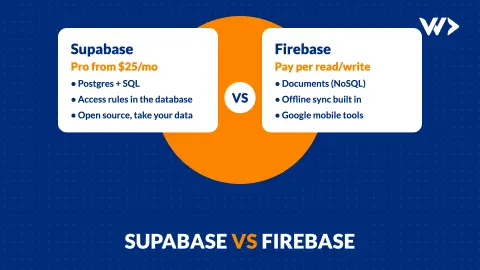
Supabase vs Firebase (2026): Which One for Your App?
Supabase or Firebase in 2026? A comparison from a team running three products on Supabase: data model, security, prices checked 19 Nov 2026, and how to choose.


Claude Fable 5.2 Tested on Two Real Bugs: Is It Worth It?
Claude Fable 5.2 launched on 9 Nov 2026. We gave it and Opus 5.5 two real bugs from our own site: both found the cause, Opus at less than half the cost.
Custom Web Application Development: Cost, Process and What Goes Wrong (2026)
What does a custom web application cost, how is it built and where does it go wrong? Day rates, a worked example and two real projects: Waterleau and RAS Security.