SvelteKit vs Next.js (2026): Why We Moved Our Site


Short answer: pick SvelteKit for content-heavy websites and small to mid-sized web apps where speed, SEO and a small codebase matter most. Pick Next.js (React) for large applications with many third-party integrations, complex shared state, or a team you need to grow quickly, because far more developers know React. We run our own five-language website and a client webshop on SvelteKit, and we still build in React and Next.js when the project calls for it. This post explains why we switched, and the 2026 update at the end compares both side by side.
Why we started using a “niche” frontend language in production.
React rules the web development landscape for almost 10 years. At We Do Dev Work, we’ve done plenty of projects in React as well as Next.js, which added server-side before React did themselves. React is great for single page applications (SPA’s)!
But, the world of web development includes much more than SPA’s.
The importance of server side rendering
The flaws of React were well known in the community. Developers needed some way of building SEO friendly websites that don’t require huge JavaScript overhead.
Vercel stepped in with a solution and Next.js was born. Instead of rendering every element on the client side, Next.js runs some of your JSX code on a server and renders elements there. Combined with some caching, this allows for faster loading times, less resource consumption on the client side and better SEO scores on the web.
What Next.js got wrong
For Vercel however, building a framework isn’t a great business model, it requires a lot of very good software engineers and generally isn’t monetizable because there are so many open source options out there. Vercel isn’t in the business of building frameworks, they are primarily a serverless cloud provider. And that’s where Next.js goes wrong…
Because Vercel wants to sell you their servers and bills you for every request made to those servers, they started recommending questionable practices in their Next.js framework. Everything now has to be done on the server side, according to their official documentation. Server-side operations are abstracted, and default settings generally take up more server resources (think of Next.js Image for example). This makes it incredibly difficult to optimize a Next.js application for cost, and often comes with longer loading times compared to static rendering techniques.
To blatantly tell a short story: Next.js is an enshittified\* framework, reopening the market for a true SEO friendly framework.
And that’s where Svelte starts to feel good
Svelte is essentially a framework that compiles an application directly into HTML and JavaScript code. It doesn’t rely on a large library (such as a virtual DOM) that has to be imported in the client application. It also offers server-side rendering, components, folder-structure based routing and other known features from React and Next.js.
The choice to use Svelte depends on the project! The Svelte approach offers a leaner codebase and smaller bundle size, making it perfect for projects that prioritize performance and code maintainability. But for complex business requirements, central state management and diverse third party integrations, React would still be preferred.
In our first project with Svelte, our own website (www.wedodevwork.com), we prioritized performance. We opted for a static site approach using the svelte static adapter that could be deployed very cheaply on a cloud distribution network. We noticed that moving to Svelte was easy because our developers were already familiar with TailwindCSS and Svelte also uses the HTML syntax within the codebase.
What makes Svelte great for SEO is its simplicity of loading data. Loading data happens either on the server, or both the server and client. It is possible to load data on every request (using hooks), but generally it’s done once and the data can be invalidated by either changing a dependency or by an intervention calling the “invalidate” function. You can also stream responses with a promise, allowing you to render content such as loading bars while waiting for the data response.
Our future with Svelte
The Svelte community is relatively small compared to React, resulting in a limited set of third party tools and libraries. And while Svelte is still growing, its small sample size of open-source codebases results in a poor vibe-coding experience. We don’t mind digging through some documentation to fill in the gaps, but it does mean we need to invest more into the learning curve that comes with Svelte adoption. It is also easier to hire new React developers to maintain a large existing codebase.
That’s why we’ll be using caution before moving every project to Svelte. But for performance critical small- to mid-sized projects it’s a great candidate as a frontend framework. If all you have is a hammer, everything looks like a nail. Luckily, we have both Svelte and React in our skillset now, and we know both frameworks’ strengths and weaknesses to make the right decision on which one to use!
If you want to build something with Svelte (or React), let us know. We Do Dev Work can help you build and optimize your web applications.
2026 update: SvelteKit vs Next.js side by side
We wrote this post in May 2026. Six months later, here is what happened with the projects mentioned above, and how the two frameworks compare today.
What we learned since
Our own site outgrew the static approach. It now serves five languages and, in our last full check on 13 November 2026, 799 pages in its sitemap. Content comes from a database, so we moved from the static adapter to server rendering on AWS Amplify. SvelteKit made that a change of adapter, not a rewrite. What we learned about hosting is in Vercel and Netlify alternatives.
A client webshop followed. For Pak Prik, a family curry paste maker in Thailand, we built a custom webshop in SvelteKit, in Thai and English, with a Thai payment provider, recipes, customer accounts and an affiliate programme. It went live in September 2026.
Smaller ecosystem, real bugs. A translation library we use added a copy of every translated list on each server request. We found it and fixed it on our side. With a smaller community, fewer people have hit the same bug before you; with React, someone usually has.
Side by side
| SvelteKit | Next.js | |
|---|---|---|
| UI library | Svelte, compiled to plain JavaScript | React, with its runtime in the browser |
| Rendering | Server, static or client per page | Server, static or client per page, with React Server Components |
| Hosting | Adapters for Node, static hosting, Vercel, Netlify, Cloudflare and others | Built by Vercel and smoothest there; also runs on your own Node server or Docker |
| Developers who use it | 7.2% of respondents (Stack Overflow survey 2025) | 20.8% for Next.js, 44.7% for React |
| Ready-made components and libraries | Fewer; you write more yourself | Very many |
| AI coding tools | Weaker suggestions, fewer examples to learn from | Strong, because there is so much public React code |
| Best fit | Content sites, webshops, small to mid-sized apps | Large apps, big teams, many integrations |
Versions on 19 November 2026: SvelteKit 3.4 with Svelte 5.58, and Next.js 16.4. Survey figures from the Stack Overflow Developer Survey 2025.
How we decide per project
Who maintains it after launch? If your own team or another agency takes over, React is easier to staff.
Is it mostly pages or mostly app? Pages that must rank and load fast lean SvelteKit; dashboards full of integrations lean React.
Which libraries are must-haves? Check before choosing. If a key component only exists for React, that decides it.
Weighing a framework for a new project, or stuck with one that no longer fits? See what custom web application development costs, or tell us what you are building. A senior developer costs $575 a day on a project, in your own repository.
Related reading
Frequently asked questions
Why did We Do Dev Work start using Svelte?
They wanted performance and an SEO-friendly framework. Svelte compiles an application directly into HTML and JavaScript without a large client-side library, giving a leaner codebase and smaller bundle size.
What does the post say went wrong with Next.js?
It argues that because Vercel sells servers and bills per request, Next.js pushes server-side work and defaults that use more server resources, making it hard to optimize for cost.
When is React still the better choice than Svelte?
For complex business requirements, central state management and diverse third-party integrations. It is also easier to hire React developers to maintain a large existing codebase.
What are the downsides of Svelte mentioned?
The community is small compared to React, so there are fewer third-party tools and libraries, and few open-source codebases make for a poor vibe-coding experience. The learning curve also needs more investment.
What was their first Svelte project?
Their own website. They used a static site approach with the Svelte static adapter, deployed cheaply on a content delivery network.
Is SvelteKit better than Next.js in 2026?
For content-heavy websites and small to mid-sized apps, often yes: less code and smaller pages. For large apps with many integrations or a fast-growing team, Next.js is usually the safer choice because the React ecosystem and hiring pool are much larger.
Is it harder to hire SvelteKit developers than Next.js developers?
Yes. In the Stack Overflow Developer Survey 2025, 7.2% of respondents used Svelte, against 20.8% for Next.js and 44.7% for React. Plan for that if your own team will maintain the code.
Related articles
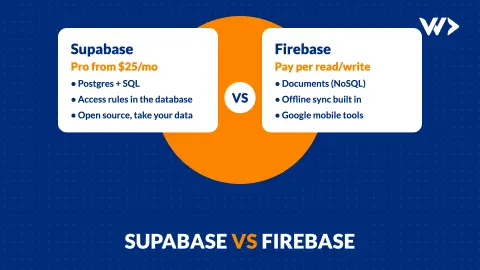
Supabase vs Firebase (2026): Which One for Your App?
Supabase or Firebase in 2026? A comparison from a team running three products on Supabase: data model, security, prices checked 19 Nov 2026, and how to choose.


Claude Fable 5.2 Tested on Two Real Bugs: Is It Worth It?
Claude Fable 5.2 launched on 9 Nov 2026. We gave it and Opus 5.5 two real bugs from our own site: both found the cause, Opus at less than half the cost.

Proposals Clients Sign: Options, Versions and Online Signing
What we learned moving our proposals from PDFs to signed online pages: let clients choose options, keep versions, lock what was signed, know when it is read.