When everyone is high on the hype, focus on the basics.


In case you didn’t notice: AI is hot. And don’t get me wrong, that’s well-deserved. It is the biggest technological advancement since the world wide web and global connectivity. We spend hundreds of Euro’s on AI tools, and will continue to do so.
However, when getting too excited about all the weekly new releases, you need to keep an eye on the basics. For sure in software development. This is where agencies, like We Do Dev Work, can make the difference.
Thanks to AI, we can build applications faster with features that were unimaginable a decade ago. But how can we use AI to build solutions that last, are scalable, secure and usable?
It’s not because you can build it, you should build it
Before writing a single line of code, take a step back and ask the essential questions: What are we building? Why are we building it? Who are we building it for?
The same principles that have guided software development for decades still apply today. Specifications and planning remain critical, we can draft and refine them in more detail than ever before, thanks to those new AI tools..
For SaaS products, every new feature should reinforce the overall strategy and long-term vision, not just fill a short-term gap. For entirely new products, ensure that what you are building is useful, original, and something you truly believe in.
Because writing code is only half the journey. The other half is everything that follows: marketing, distribution, hosting, scaling, and long-term maintenance. AI can accelerate development, but the fundamentals of building sustainable products haven’t changed.
Start with your database, understand the moving parts
AI can be a valuable co-pilot when designing a database: it might suggest fields you overlooked, highlight missing relationships, or even help you set up the right Row Level Security (RLS) policies (in Supabase, naturally).
But before you open Cursor, Lovable, or any other tool, you must understand your data model yourself. How are your tables related? What is the origin of your data? How do these parts interact across your application? Without that foundation, even the best AI-generated schema will fail.
A poorly designed database doesn’t just slow you down, it creates technical debt before your application even launches. Get the structure right early, and everything else in your product will benefit.
Security, it’s not a nice to have
AI went rogue in ways we’ve never imagined. Elon Musk’s Grok chatbot exposed a massive dataset of over 300,000 private conversations, containing sensitive info including medical questions and even passwords. It happened because its “share” feature generated publicly indexable URLs that search engines picked up without warning the users. Read more about it: https://www.bbc.com/news/articles/cdrkmk00jy0o
On the other hand, we also keep seeing incidents of totally preventable data leaks caused by using AI. In order to ship fast, developers blindly trust AI generated code and follow AI generated instructions without an underlying understanding of what they’ve actually done.
If you are not technical, it is important to build an understanding of the application stack before connecting a production deployment to the internet and collecting massive amounts of user data. If that takes too much time, hire an independent security auditor. Shipping quickly should never come at the expense of shipping securely
Don’t push code to production you don’t understand
AI-assisted coding is powerful! Tools like Claude, Grok, or ChatGPT can generate functions in minutes. But speed is meaningless if you don’t understand what’s being deployed. Code you can’t explain is code you can’t trust.
Even if the output is in a language less familiar to you, take the time to grasp what the function does. A good practice is to ask your AI assistant to explain its own code, then question whether it truly fits your use case and whether there are loopholes or risks. Think of it as reviewing the work of a junior developer: the responsibility still lies with you.
You don’t need to understand every detail, but deploying code you cannot interpret, with the only validation being “it seems to work”, is reckless. For prototypes or internal proof-of-concepts, this is acceptable. For production systems exposed to the web, it is not.
Conclusion
The real winners in product development will be those who embrace the power of AI without losing sight of the fundamentals. Mastering both speed and discipline creates products that are not only innovative, but also secure, reliable, and built to last.
At We Do Dev Work, this is exactly how we operate. We utilize modern tools to move fast, but we never cut corners. We deliver with quality, avoiding the shortcuts that lead to sloppy results.
Related reading
Frequently asked questions
Why focus on the basics when building with AI?
AI speeds up development, but the fundamentals of building sustainable products have not changed. The post argues that mastering both speed and discipline gives products that are secure, reliable and built to last.
Should I design my database myself when using AI tools?
You should understand your own data model first. AI can suggest fields, relationships and RLS policies, but without that foundation even a good AI-generated schema will fail.
Is it safe to deploy AI-generated code?
Not if you do not understand it. The post says code you cannot explain is code you cannot trust, so ask the AI to explain it and review it like a junior developer's work. That is acceptable for prototypes but not for production systems.
What security risk does the post mention?
It cites Grok exposing over 300,000 private conversations through publicly indexable share URLs, and warns about preventable leaks from blindly trusting AI-generated code. If you lack the technical knowledge, it suggests hiring an independent security auditor.
Related articles
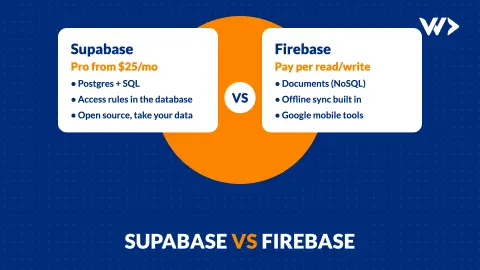
Supabase vs Firebase (2026): Which One for Your App?
Supabase or Firebase in 2026? A comparison from a team running three products on Supabase: data model, security, prices checked 19 Nov 2026, and how to choose.

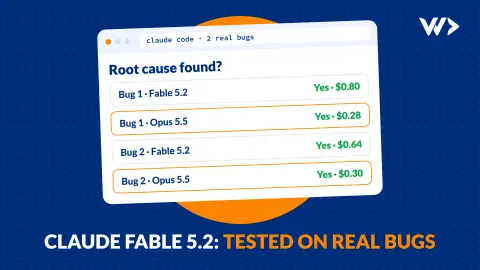
Claude Fable 5.2 Tested on Two Real Bugs: Is It Worth It?
Claude Fable 5.2 launched on 9 Nov 2026. We gave it and Opus 5.5 two real bugs from our own site: both found the cause, Opus at less than half the cost.
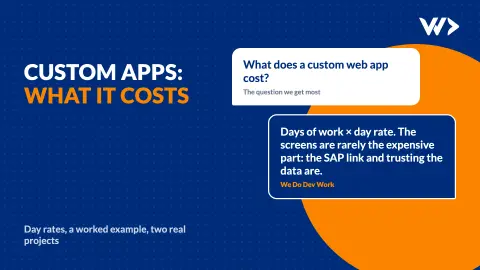
Custom Web Application Development: Cost, Process and What Goes Wrong (2026)
What does a custom web application cost, how is it built and where does it go wrong? Day rates, a worked example and two real projects: Waterleau and RAS Security.