CEO insight: The state of e-commerce after the pandemic spike


What is e-commerce
E-commerce is simply the buying and selling of goods or services over the internet. That can be anything from ordering a pair of sneakers on Zalando, paying for a Spotify subscription, or buying digital Labubu cards at 2 AM, all because you “just wanted to check the price.” If money changes hands and it happens online, it’s e-commerce.
Some numbers to set the scene
Before 2020, e-commerce was growing nicely (more than steady) at 12–14% per year. Then the pandemic arrived and threw petrol on the fire. In 2020 and 2021 global online retail sales jumped more than 25% in many markets. People stuck at home suddenly bought everything online: bread makers, dumbbells, toilet paper, video games, and probably a few things they now regret (those plastic dumbbells that are somewhere on the floor).
From 2022 onward, growth slowed to a more civilised 8 – 10 % per year, but here’s the key point: the new baseline is set in stone.
In the U.S., e-commerce now makes up about 16% of total retail sales (up from 11% in 2019). Europe is around 15%, with leaders like the UK and the Nordics punching higher. China is in a league of its own, with more than 30% of all retail happening online.
Regional differences
Europe is, as always, a patchwork. Northern countries adopted faster thanks to high internet penetration and good logistics. Southern Europe is slowly catching up, though delivery to a Greek island can still test your patience.
USA remains the benchmark for scale, with Amazon setting customer expectations on delivery speed and returns.
Asia, especially China and Southeast Asia, plays a different game entirely. Live shopping streams, mobile payments, and super-apps make the Western experience look like dial-up.
The e-commerce ecosystem
Behind the “add to cart” button hides an entire nerdy universe:
Delivery networks are racing to get packages from dark warehouses to your doorstep in less than a day.
Internet infrastructure that makes checkout pages load faster than a Belgian cyclist descending the Mont Ventoux.
Payment providers are fighting to shave milliseconds off transactions while keeping fraudsters out.
SaaS tools everywhere: invoicing apps, email automation, analytics dashboards, 3D product viewers… You name it.
It’s a complex, beautiful machine that keeps getting smarter.
Are online services also e-commerce?
Here’s a debate for your next coffee break: Is paying for Netflix, ChatGPT, or a cloud storage plan “e-commerce” or just “digital services”?
Economists will argue definitions, but for most businesses, it doesn’t matter. If you can take money online, you play in the same sandbox.
We would say: it’s e-commerce.
The road ahead
Despite political tension, Trump-style tariffs, and the occasional global recession scare, e-commerce is set for continuous growth.
Expect global online retail to pass 7 trillion USD by 2025 and keep climbing.
The growth will be steadier than the pandemic spike, but no less inevitable as younger generations treat online shopping like breathing.
Should you invest in e-commerce?
Absolutely.
The question is not if but how:
Build your own online store with a strong tech stack.
Expand to marketplaces but keep control over your brand.
Automate operations early to avoid drowning in manual work.
At We Do Dev Work, we help companies build the right foundations: from custom web apps to fast Shopify stores, Supabase back-ends, and clever automations.
We design, code, and deliver so you can focus on selling, whether it’s shoes, supplements, subscriptions, or that next big idea.
Related reading
Frequently asked questions
How fast is e-commerce growing after the pandemic?
Before 2020 it grew 12-14% per year and jumped over 25% in many markets in 2020 and 2021. From 2022 growth slowed to roughly 8-10% per year.
How big is e-commerce as a share of retail?
The post puts it at about 16% of US retail sales (up from 11% in 2019), around 15% in Europe, and more than 30% in China.
Is paying for Netflix or ChatGPT e-commerce?
Economists may argue about definitions, but the post's view is that if you can take money online, you are playing in the same sandbox, so it counts as e-commerce.
Should businesses invest in e-commerce?
The post says yes, and that the question is how. It suggests building your own store on a strong tech stack, expanding to marketplaces while keeping control of your brand, and automating operations early.
Related articles
Webshop Down on Black Friday 2026? What to Do First
Black Friday 2026 is 27 November. If your webshop goes down or checkout breaks mid-sale, here is what to check in the first 15 minutes and when to get help.

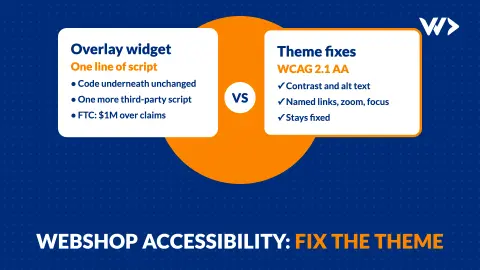
Webshop Accessibility (EAA): What to Fix, Why Overlays Fail
What the European Accessibility Act means for your webshop: the 7 technical fixes most shops need, real scan numbers, and why an overlay widget is not the fix.
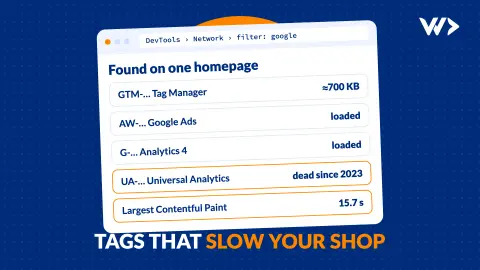
Google Tag Manager Slowing Down Your Shop? Clean Up Tags Safely
A real webshop scan: 547 requests, four Google IDs and an LCP of 15.7 seconds on a phone. How to find which tracking tags slow your shop and remove them without losing your data.